

The podcast analyzes China’s 15th Five-Year Plan (2026–2030) and what it signals about the country’s ambition to achieve technological self-reliance and global tech leadership. Drawing on the plan itself, China’s government work report, and analyses from international institutions, the discussion frames the strategy as a major shift from China’s traditional growth model to a technology-driven economy.
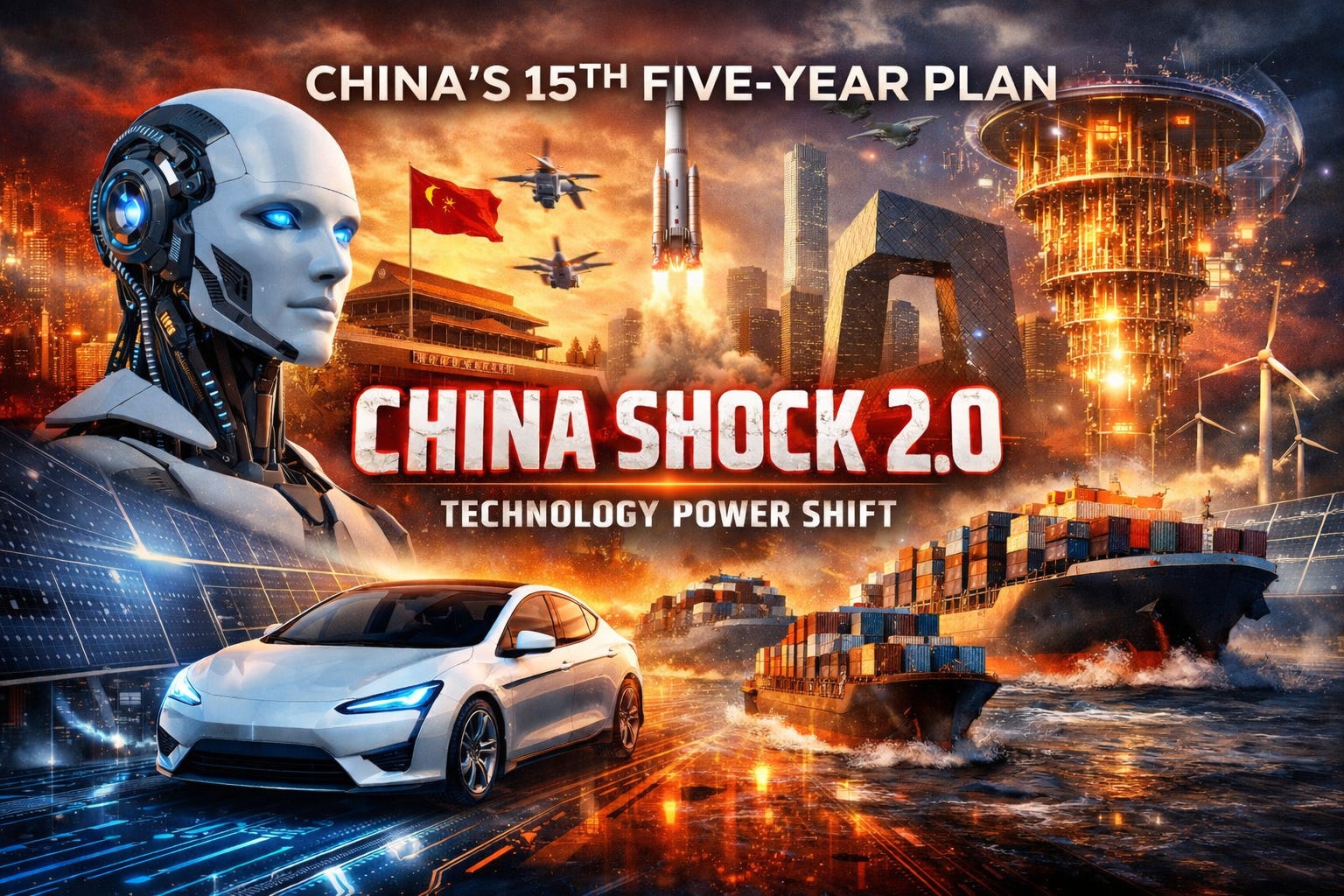
1. A Shift From “Factory of the World” to Tech Powerhouse
For decades, China followed a “fast follower” model, scaling and manufacturing technologies developed elsewhere. The new plan signals the end of that approach.
The new guiding concept—“new quality productive forces”—prioritizes:
Artificial intelligence
Quantum computing
Humanoid robots
Biomanufacturing
6G telecommunications
Electric vehicles and batteries
The “low-altitude economy” (drones and flying mobility)
The goal is to replace the old growth engines of real estate and infrastructure with innovation-driven industries.
2. AI Everywhere: A Deep Integration Strategy
China aims to integrate AI agents into most digital systems.
Targets include:
70% AI penetration by 2027
90% by 2030
This means AI embedded across manufacturing, logistics, healthcare systems, and city infrastructure—turning AI into a core economic driver rather than just software tools.
3. “China Shock 2.0”: Global Industrial Disruption
Analysts warn that China’s massive industrial push could create a new wave of disruption similar to the manufacturing shock after China joined the WTO.
But unlike the first wave, which affected low-cost manufacturing, this new wave targets high-tech industries, including:
Electric vehicles
Solar panels
Batteries
Advanced electronics
Heavy subsidies allow Chinese companies to produce more than the domestic market can absorb, leading to aggressive exports of underpriced products that threaten industries in Southeast Asia, Europe, and emerging markets.
4. The Two-Speed Chinese Economy
Despite the high-tech push, China’s domestic economy faces structural problems:
Weak consumer demand
A collapsing property sector
High youth unemployment
Local government debt
The result is a “two-speed economy”:
High-tech sectors sprinting ahead
Domestic consumption struggling
China is betting that technological leadership will create the next growth engine to replace real estate.
5. “Involution”: Brutal Competition at Home
The podcast highlights the concept of “involution”—an intense internal competition among Chinese firms.
The electric vehicle sector illustrates this dynamic:
Hundreds of EV startups emerged due to subsidies
Fierce price wars eliminated weaker firms
Survivors such as BYD became extremely efficient but must expand overseas to remain profitable
This domestic pressure cooker produces globally competitive companies.
6. Signs of Technological Breakthroughs
The discussion highlights several developments suggesting China is rapidly closing the tech gap with the United States:
AI models from companies like DeepSeek are achieving top-tier performance with fewer chips
Research on carbon nanotube chips outperforms cutting-edge silicon chips
Advances in quantum computing prototypes
However, analysts stress an important distinction:
Scientific breakthroughs are not the same as mass commercial production.
China still trails the West in key foundational areas, such as advanced chip manufacturing, which is dominated by companies like TSMC.
7. The Core Question
The central debate remains unresolved:
Will China surpass the United States as the world’s dominant technology power by 2030?
The answer likely depends on whether China can:
scale breakthrough technologies commercially
maintain economic stability
overcome export controls and supply-chain constraints.
Reference
U.S.-China Economic and Security Review Commission 2025 Report to Congress
The Power of Innovation: The Strategic Value of China’s High-Tech Drive
China’s AI Policy at the Crossroads: Balancing Development and Control in the DeepSeek Era
China aims for AI application breakthroughs in key sectors in next 2 years: official
China aims for fivefold increase in advanced chip output to meet AI demand
China’s Facilitation of Sanctions and Export Control Evasion
China’s New Quantum Machine Runs One Million Times Faster Than Google’s


