

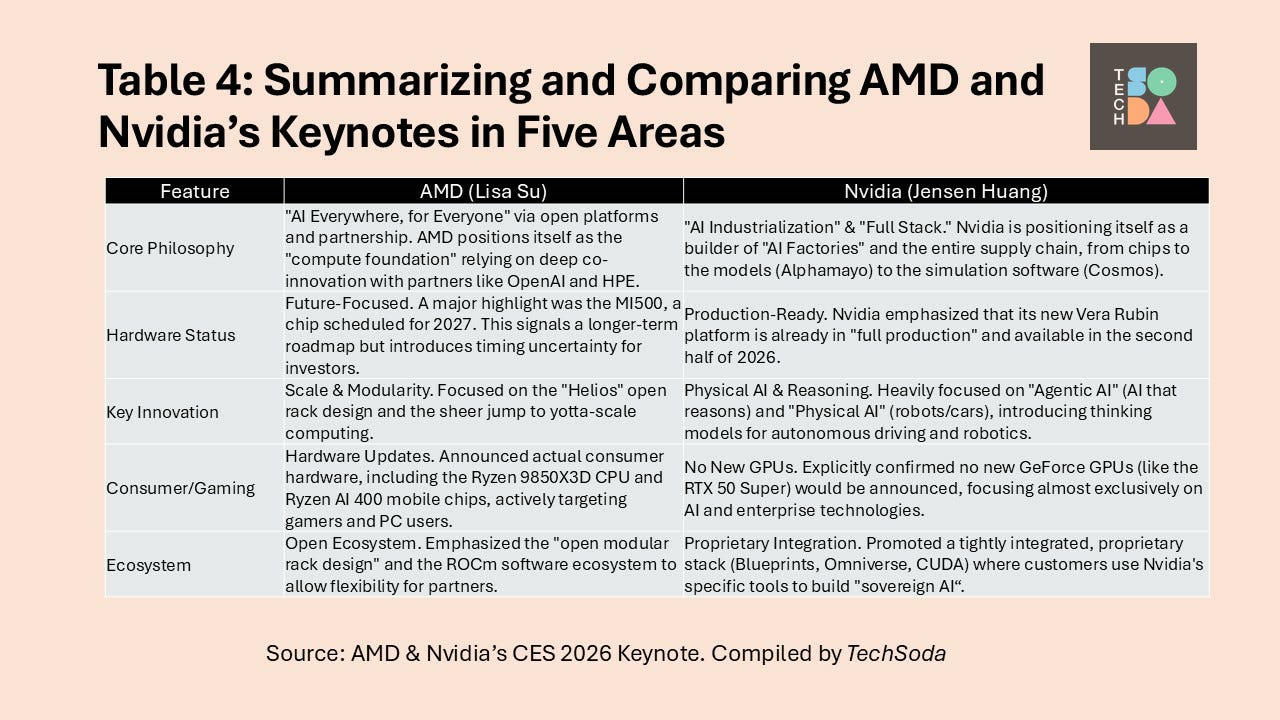
As the curtain rises on the 2026 Consumer Electronics Show, the semiconductor landscape is no longer just about who has the fastest chip. The keynote addresses from Nvidia and AMD have signaled a definitive shift: we are entering the era of the “Industrialization of AI.”
While both companies are chasing a market projected to reach “yotta-scale” compute in the next five years, their strategies for getting there represent two fundamentally different worldviews.
1. Data Center Architectures: The Race to Yotta-Scale
The primary challenge defining this decade is “token inflation.” As Large Language Models (LLMs) grow by 10x in complexity every year, the cost of generating every single AI token threatens to become economically unviable.
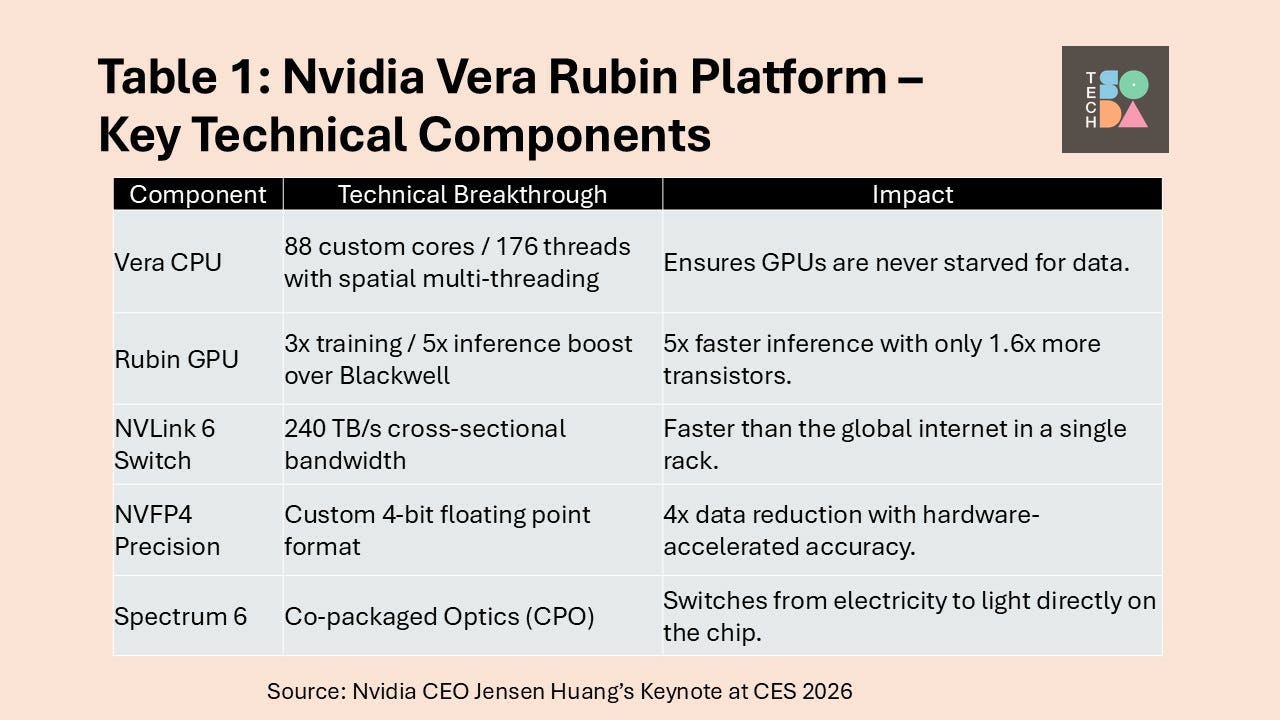
Nvidia: The “Vera Rubin” Full-Stack Supremacy
Nvidia’s answer is a radical co-design approach. Instead of a single GPU, they have unveiled a six-chip constellation known as the Vera Rubin platform. By controlling everything from the CPU to the fiber-optic networking, Nvidia aims to drop inference costs by a factor of 10.
AMD: The “Helios” Open Modular Blueprint
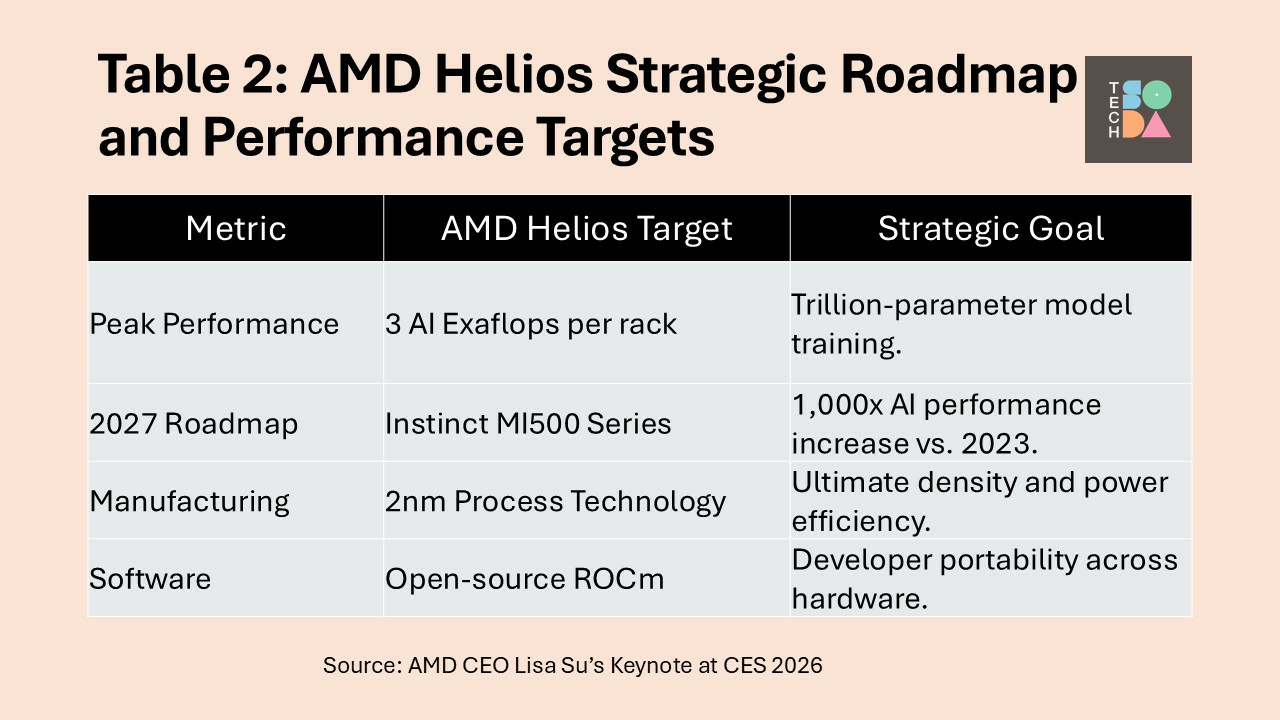
AMD is countering with Helios, a roadmap that champions choice and modularity. Their strategy is built on avoiding “vendor lock-in,” allowing cloud providers to mix and match components using the open-source ROCm software stack.
2. The Efficiency Mandate: “Green” as a Competitive Edge
AMD has positioned energy efficiency not just as a corporate responsibility goal, but as a primary architectural directive. Having surpassed their “30x25” goal (achieving 38x efficiency), they have set a new benchmark for the industry.
Comparison of Rack Efficiency
A comparison of the infrastructure needed to train a major AI model:
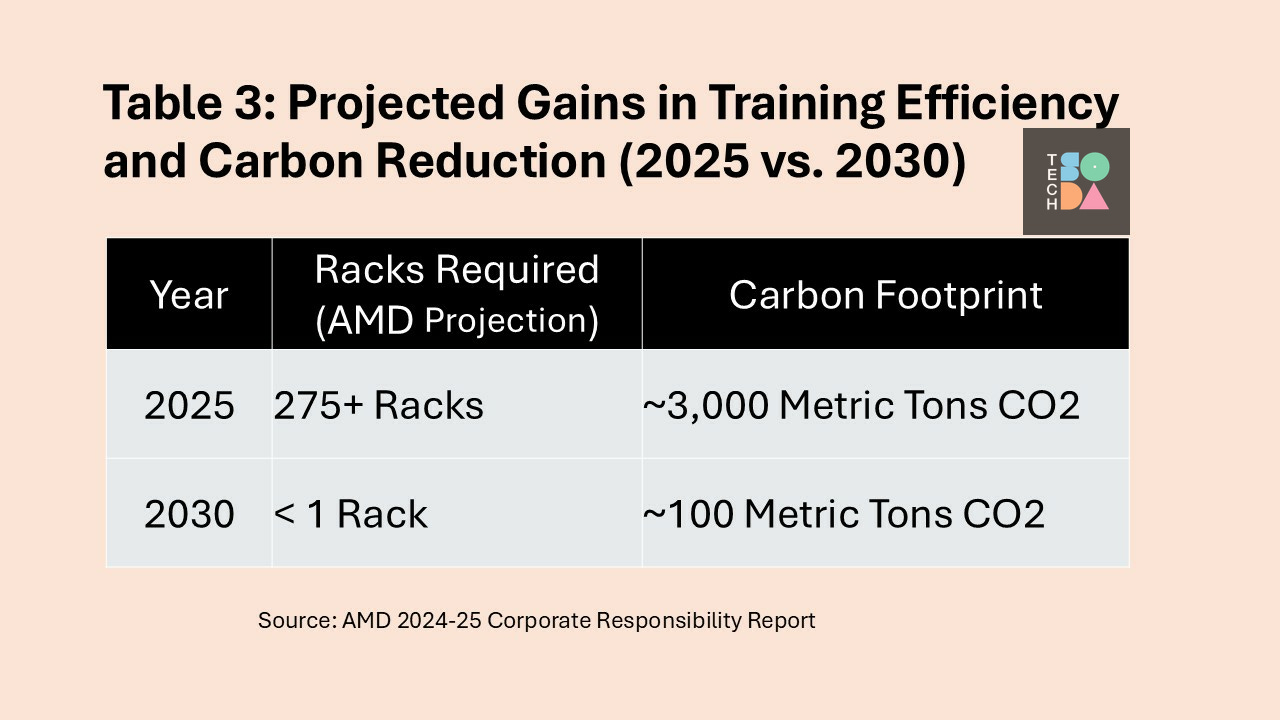
This 20x rack-scale efficiency improvement by 2030 is AMD’s “all-or-nothing” bet, aimed at hyperscalers who are increasingly constrained by power-grid limitations.
3. Physical AI and the “ChatGPT Moment” for Robotics
Nvidia is moving AI beyond screens into the physical world through its “Three-Computer Approach”:
Training: AI brains developed on supercomputers.
Simulation: Omniverse and Cosmos (World Foundation Models) generate synthetic data for edge cases (e.g., a truck dropping debris at night).
Inference: Jetson Thor and Drive AGX Thor processors powering humanoid robots and autonomous vehicles.
Key Deployment News:
Uber/Lucid/Neuro: A production-intent RoboTaxi aimed for a 2026 launch.
Mercedes-Benz: Rolling out Level 2 features in the US (Q1 2026) using Nvidia’s “Halo” safety stack.
GR00T 1.6: A general-purpose robot model capable of Vision-Language-Action (VLA), allowing robots to understand and execute complex physical tasks.
4. The AI PC: Local Intelligence
AMD remains the leader in the “Client AI” space, focusing on putting supercomputing power into laptops.
Ryzen AI 400 Series: Setting a 60 TOPS (Tera Operations Per Second) baseline for NPUs.
Ryzen AI Max Plus: Supporting up to 128 billion parameter models locally with 128GB of unified memory.
The goal is privacy and speed—allowing developers to debug code or edit video without sensitive data ever leaving the device.
Conclusion: An “Ecological War”
The journalistic takeaway from CES 2026 is that we are witnessing an “ecological war.” Nvidia is building a “walled garden” so high and so optimized that it is hard to leave, while simultaneously releasing open models (Cosmos, AlphaMayo) to ensure their hardware becomes the default infrastructure for the open-source world.
AMD, conversely, is building the “open highway,” betting that the industry will eventually recoil from proprietary stacks in favor of modular, ultra-efficient, and ethically-governed systems. Whether the winner is the Integrated System or the Open Ecosystem, the result for the consumer is the same: the cost of intelligence is about to plummet.
References:
Nvidia CEO Jensen Huang’s keynote at CES 2026
AMD Chair and CEO Lisa Su’s keynote at CES 2026
AMD 2024-25 corporate responsibility report
https://pcper.com/2026/01/ces-2026-amd-client-and-graphics-update-includes-ryzen-9850x3d-cpu/
https://the-decoder.com/ces-2026-nvidia-promises-five-times-the-ai-performance-and-ten-times-cheaper-inference-with-vera-rubin/


