

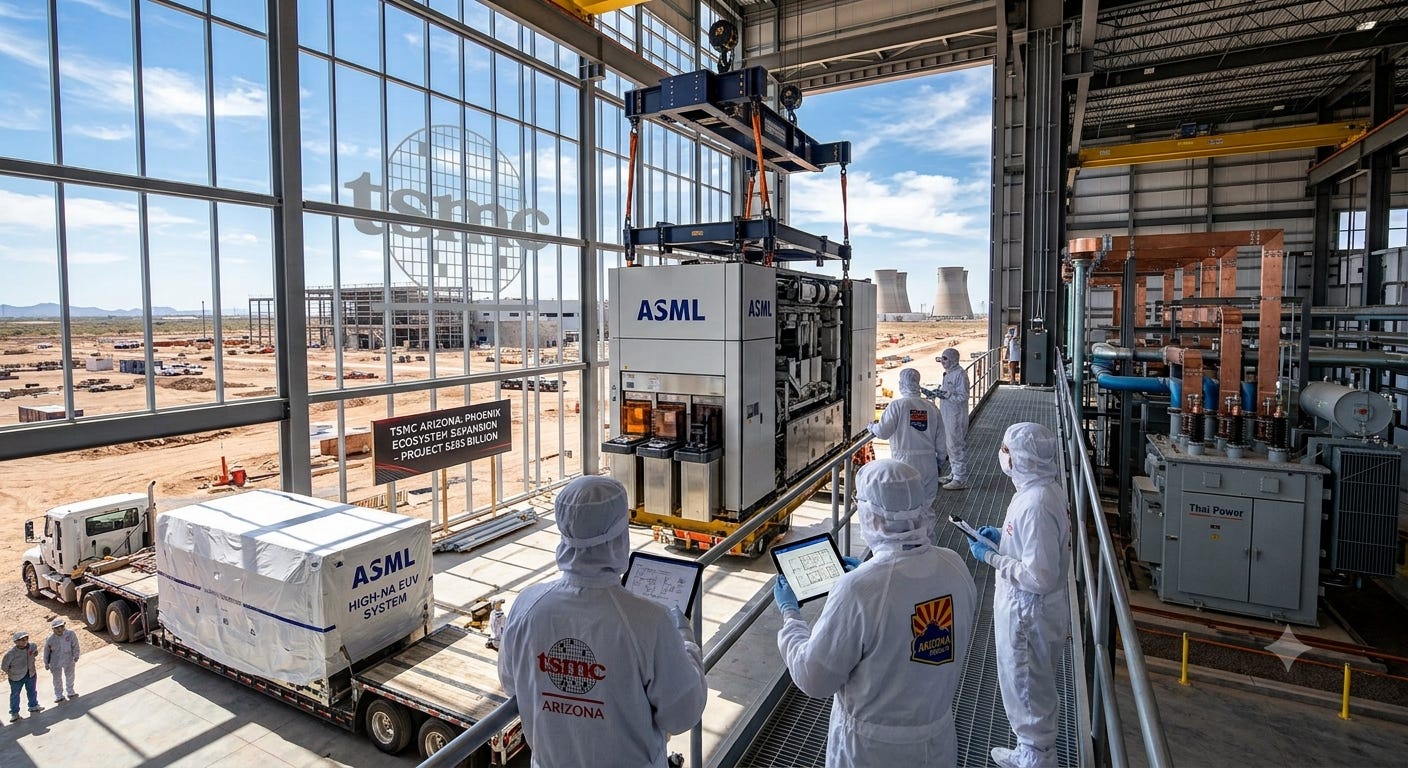
In the high-stakes theater of global geopolitics, few corporate maneuvers match the scale of Taiwan Semiconductor Manufacturing Company’s (TSMC) massive expansion. In its Q2 2026 earnings call, the semiconductor titan stunned the tech sector by announcing an additional $100 billion investment in its Phoenix, Arizona ecosystem. This fresh injection of funds will add four additional fabs—including cutting-edge 2-nanometer logic foundries and highly complex advanced packaging facilities—bringing TSMC’s total U.S. commitment to a jaw-dropping $265 billion across 12 planned facilities.
While Washington celebrates this as a historic diplomatic triumph, the reality on the ground is a delicate balancing act. TSMC must satisfy its most lucrative clients and Western regulators while executing an insanely complex construction plan in the American desert—all while desperately protecting the “Silicon Shield” that keeps Taiwan indispensable to the global economy.
The Mandate: Why “No” Was Never An Option
To understand why TSMC is dropping an eleventh-digit fortune into the Arizona desert, one only needs to look at its balance sheet. Leading American tech entities—including Nvidia and Apple—account for a massive 78% of TSMC’s total revenue.
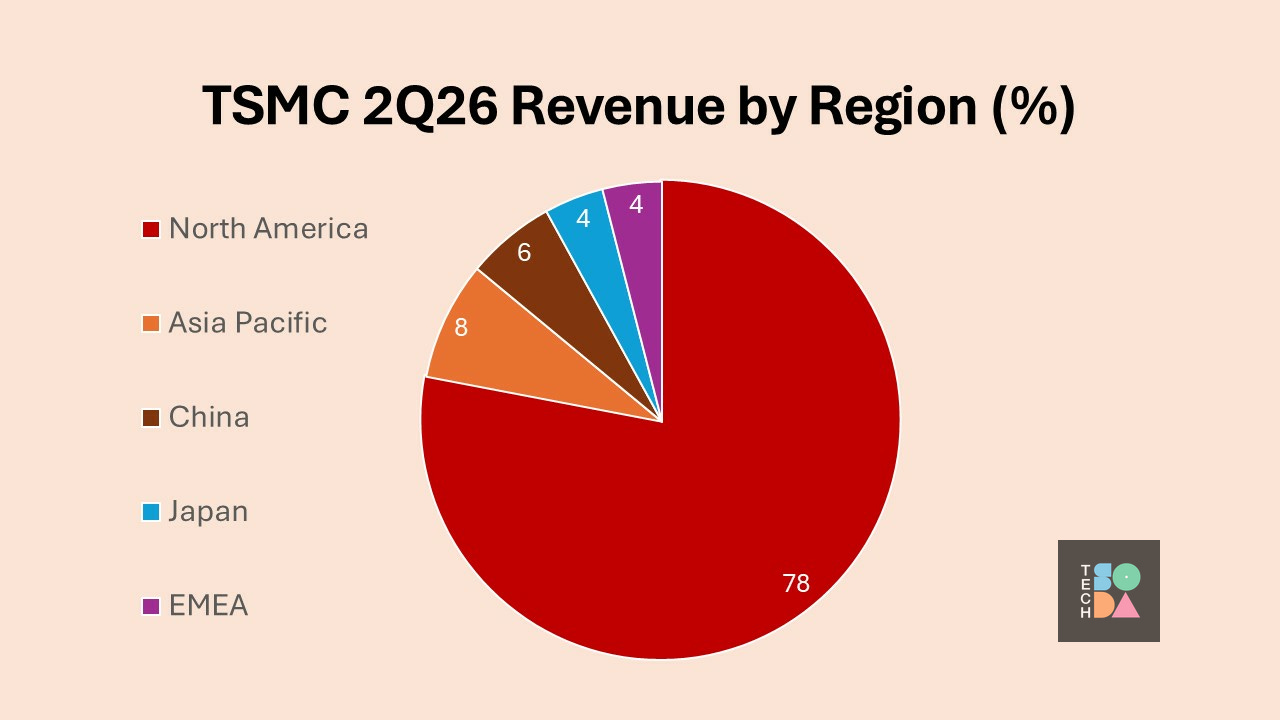
When customers writing nearly four-fifths of your checks demand localized supply chain resilience, saying “no” is a corporate impossibility.
The Speed of Innovation: For tech behemoths pushing the boundaries of artificial intelligence, operating at “market speed” is everything. Physical proximity enables design technology co-optimization, allowing TSMC and its U.S. clients to prototype, test, and iterate rapidly.
The Geopolitical Reality: The U.S. currently manufactures roughly 10% of global microchips, while East Asia dominates at 80%. Washington’s strategic directive to reach 30% domestic production by 2030 carries immense political weight. Raymond Greene, director of the American Institute in Taiwan (AIT), hailed the expansion as a “powerful signal of trust,” proving that TSMC must stand shoulder-to-shoulder with its Western patrons.
The Energy Myth vs. The Reality of Advanced Packaging
According to Taipower’s latest internal assessment, ongoing capacity expansions in wafer fabrication, high-bandwidth memory (HBM), and advanced packaging and testing are expected to drive the semiconductor industry’s electricity consumption to approximately 52 billion kWh this year.
Taipower forecasts that semiconductor power demand will double within the next decade to around 110 billion kWh, increasing the sector’s share of Taiwan’s total electricity consumption from the current 17% to 30%. The rapid adoption of artificial intelligence (AI) is making electricity demand increasingly voracious.
A common misconception trailing TSMC’s Arizona expansion is that the company is fleeing Taiwan’s notorious power constraints. Analysts initially speculated that TSMC might be offloading its most energy-hogging operations to the U.S. while keeping “lightweight” back-end tasks at home.
That theory fundamentally misunderstands modern semiconductor architecture. “Packaging” in the AI era doesn’t mean cardboard boxes and tape; it means building a high-density, three-dimensional metropolis out of silicon.
TSMC’s signature advanced packaging technology, CoWoS (Chip-on-Wafer-on-Substrate), places multiple chips and memory banks side-by-side on a microscopic silicon “interposer” highway. Building these structures requires complex photolithography, massive automated clean rooms, and industrial-scale cooling systems to keep the dense computing clusters from literally melting down.
Far from running away from this energy-intensive process, TSMC is actually doubling down at home, breaking ground on 13 new fabs in Taiwan—including three massive advanced packaging plants in the Chiayi Science Park.
The Desert Gauntlet: Structural Hurdles to a $100 Billion Plan
Building the most advanced manufacturing facilities in human history is tough. Replicating them in an environment thousands of miles away from your primary supply network is a logistical gauntlet. TSMC faces three existential headwinds in Arizona:
1. The Supply Chain Drop-Off
A semiconductor fab does not exist in a vacuum; it requires a hyper-specialized network of chemical suppliers, logistics experts, and precision engineers. While the $265 billion ecosystem is meant to act as a gravitational pull, the financial friction of U.S. industrial construction is stalling the migration. Out of TSMC’s roughly 3,000 global suppliers, only about 100 currently have the capital capacity to relocate. Soaring prices for raw materials—like copper, steel, specialized cement, and chemical piping—make building American extensions prohibitively expensive for second-tier Taiwanese suppliers.
2. The Talent Shortage
By 2030, the U.S. semiconductor sector is staring down a deficit of up to 157,000 full-time workers, with 74% of those unfilled roles in manufacturing and engineering. The core issue is an educational pipeline bottleneck: the U.S. graduates fewer than 100,000 electrical engineering and computer science students annually, and the vast majority choose highly lucrative software or AI roles. Designing apps from a remote couch is simply a softer sell than pulling 12-hour shifts in a highly pressurized clean room bunny suit.
3. Equipment Inflation
To print features at the atomic level, TSMC relies on Extreme Ultraviolet (EUV) lithography machines from Dutch manufacturer ASML. These machines—which generate EUV light by blasting molten tin droplets with high-power lasers 50,000 times a second—cost upwards of $400 million per unit for next-generation High-NA variants. With equipment makers pushing 10% price hikes, TSMC is forced to leverage its 73% global foundry market dominance to mount fierce resistance against margin-diluting equipment inflation.
Guarding the Secret Sauce: How Taiwan Maintains the “Silicon Shield”
The rapid buildout of American fabs has ignited intense anxiety in Taipei: if the U.S. achieves semiconductor self-sufficiency, does Taiwan lose its “Silicon Shield”—the geopolitical leverage that ensures global powers will defend the island from conflict?
To counter this erosion, TSMC and the Taiwanese government are executing an aggressive “anchor strategy.” The message is clear: Arizona will receive exceptional technology, but the absolute bleeding edge stays strictly at home.
The Taiwanese government is operating as an aggressive VIP concierge for TSMC, securing land, guaranteeing water access, and fast-tracking power grid upgrades to ensure its 13 domestic projects succeed. It’s a classic franchise analogy: TSMC is opening a high-end bistro in Arizona to satisfy its biggest spenders, but the secret sauce recipe remains locked in the home kitchen vault.
The Reality Check
Even if the U.S. successfully builds the foundries and solves its labor crisis, a glaring vulnerability remains: the back-end supply chain.
Out of nearly 500 semiconductor assembly and test facilities globally, only 65 are located in the Americas. If the U.S. manufactures raw silicon wafers on American soil only to ship them back across the Pacific Ocean for final packaging and testing, true technological independence remains an illusion. For now, the global supply chain line hasn’t been broken—it has just been made longer and significantly more expensive.
Reference
Liberty Times: AI吃電》半導體用電10年翻倍 2035年占比衝30%
DIGITIMES: 台灣到底多缺電?
TSMC 2Q26 Transcript
Bloomberg: Worker shortage endangers US chip production plans
Finance Bigo: ASML Pushes EUV, DUV Equipment Price Hikes; TSMC Pushes Back Hard


