

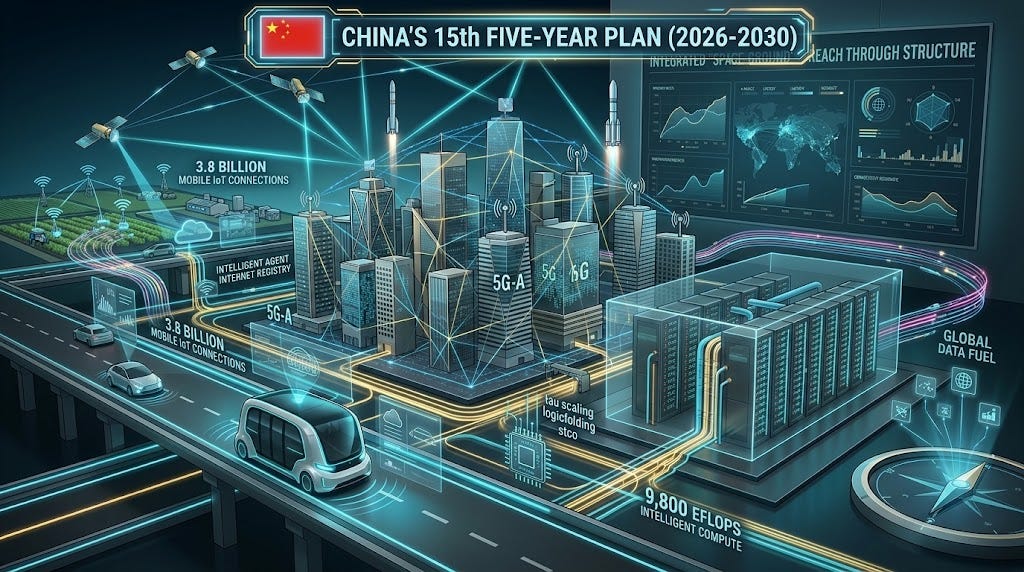
China’s Ministry of Industry and Information Technology (MIIT) formalized the 15th Five-Year Plan (2026–2030) for the Information and Communications Technology (ICT) sector, codifying Beijing's shift from chasing single-chip benchmarks to constructing a systemic, physical-world moat.
What It Means for US-China Tech Rivalry
Asymmetric Compensation for Silicon Sanctions: Export controls and lithography bottlenecks (EUV blockades) continue to restrict China’s access to sub-3nm trailing-edge fabrication. The 15th ICT Plan bypasses this bottleneck through architecture: by splitting compute loads between 5G-A cell towers, edge infrastructure, and vertically stacked STCO packages, Chinese systems achieve real-world physical AI execution without needing single-die silicon parity with Western frontier accelerators.
Infrastructure Moat vs. Software Moat: Silicon Valley’s advantage lies in software, algorithmic ingenuity, and frontier reasoning models hosted in hyperscale clouds. China is betting that real-world AI applications (autonomous logistics, automated ports, robotics, and smart grids) rely on edge data generation, not conversational fluency. The side with 3.8 billion interconnected physical nodes creates a closed-loop data engine that purely digital Western software cannot simulate.
The Global South Infrastructure Default: The rivalry will not be settled in Western enterprise software suites, but in middle-income and emerging markets across Southeast Asia, Latin America, the Middle East, and Africa. While the Western stack demands premium connectivity and expensive closed APIs, China’s 15th ICT export strategy packages open-weight models with state-subsidized 5G-A telecom gear and low-cost RedCap hardware. Once a nation builds its power, transport, and municipal services on top of Chinese physical protocols, switching costs become prohibitive.
1. Executive Overview: The Great AI Schism
The global landscape of Artificial Intelligence is fracturing into two irreconcilable strategic philosophies. The Western “iPhone-style” model, championed by elite Silicon Valley labs like OpenAI and Anthropic, prioritizes proprietary breakthroughs, high-priced subscriptions, and “genius-centric” models aiming for singular Nobel-level intelligence. In stark contrast, the Chinese “Android-style” model, codified in the 15th Five-Year Plan, leverages an open-weight, low-cost, and “reach-centric” architecture. While one seeks to build the smartest machine, the other seeks to build the world’s default digital backbone.
The “So What?”: Policy-makers must recognize that AI dominance is no longer determined by raw “Model IQ,” but by infrastructure sovereignty. The winner of this duel will be the power that successfully embeds its cognitive architecture into the physical fabric of global national sovereignty, industrial supply chains, and daily economic activity.
This philosophical divide is manifesting in a massive physical build-out, as the “Android” model moves from digital software to a physical digital nervous system.
2. The Thesis: Reach as a Competitive Advantage
Strategically, Kai-Fu Lee posits that “reach,” “footprint,” and “usage” are more potent long-term moats than raw compute power. The “Android” model wins by lowering the barrier to entry, offering the “global majority” access to intelligence that is “good enough” for a fraction of the cost.
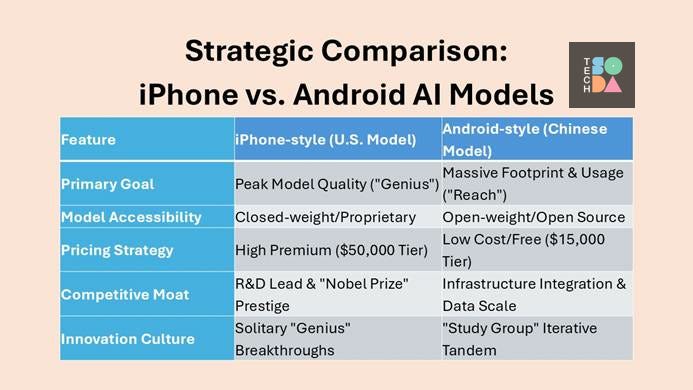
A critical cultural-operational divide exists here: while Silicon Valley is preoccupied with the prestige of singular breakthroughs, Chinese engineers operate as a “study group,” sharing innovation through open weights. They prioritize “not glorious, not interesting” engineering work that simply “gets the job done,” allowing them to move in tandem across industrial applications.
3. The Digital Nervous System: 3.8 Billion IoT Nodes
China’s 15th Five-Year Plan targets 3.8 billion mobile IoT connections by 2030, establishing the “data fuel” for the Android model. These nodes are not mere connectivity points; they are the sensory organs and actuators for a national army of AI agents.
High-Priority Sectors and Learning Benefits:
Car-Road-Cloud (C-V2X): Generates a volume of real-world edge operational data regarding traffic flow and physics that Western software-only ecosystems cannot match.
Industrial/5G-A Factories: Digitizing production lines creates a self-correcting feedback loop, providing AI with proprietary “Physical AI” data on material science and logistics.
Smart Cities (City Information Models): Sensors acting as municipal “nerves” allow AI agents to learn structural health and energy grid management at a planetary scale.
Consumer Devices (AI Glasses/Robots): Persistent, low-power connectivity ensures a continuous stream of human behavioral data to refine agent interaction.
Technical Insight: 5G RedCap & 5G-A (Advanced) To make 3.8 billion nodes economically viable, the plan mandates 5G RedCap (Lightweight) to strip hardware complexity and lower costs. More critically, it integrates 5G-A (5G-Advanced) and “通感融合“ (Integrated communication-sensing-computing). This allows the network itself to sense and compute, splitting the cognitive load between the device and the infrastructure.
4. Physical AI: Virtual Simulation vs. Sovereign Infrastructure
The transition to “Physical AI” reveals two competing visions of how machines should navigate reality.
Nvidia’s “World Simulators”: Frameworks like Cosmos and GR00T use high-fidelity virtual simulations to teach robots physics before deployment. Nvidia’s Alpamayo model places the “cognitive load” on the individual edge device (e.g., a Mercedes-Benz CLA), requiring massive on-board reasoning.
China’s “Intelligent Agent Internet” (智慧體互聯網路): China is building a sovereign network layer specifically for AI agents, featuring its own identity registration, domain naming, and address resolution systems.
The “So What?”: By treating AI agents as registered entities within a sovereign registry, China enables a “Car-Road-Cloud” integration where intelligence is network-coordinated. The vehicle does not reason in isolation; it shares the cognitive burden with the road and the cloud, bypassing individual hardware limitations through collective intelligence.
5. Engineering under Constraint: The Tau Scaling Law & LogicFolding
Facing Western export bans on sub-7nm tools, Chinese engineers have pivoted to System-Technology Co-Optimization (STCO). Huawei’s (Tau) scaling law and LogicFolding represent a “Physics-Alternative” to Western lithography.
The “Commute vs. Desk Work” Logic: A chip consumes energy through “Desk Work” (switching gates) and “The Commute” (moving data across wires). In large AI clusters, over 80% of energy is spent on the “commute.”
The STCO Mechanics:
Vertical Stacking: LogicFolding converts long horizontal wiring into short vertical hops via 3D hybrid bonding.
Linear Savings: This achieves a 70% wire length reduction, slashing interconnect capacitance.
The Quadratic Lever: While folding buys linear savings in capacitance, the true breakthrough is using that headroom to lower voltage. Because dynamic power is proportional to the square of voltage, dropping the Kirin 2026 voltage from 0.85V to 0.55V delivers a massive reduction in power density.
“Cooler is the way forward”: Claiming to reduce power consumption by 66% and power density by 73%, China can achieve its 9,800 EFLOPS national intelligent computing target using domestic silicon that prioritizes efficiency over raw frequency.
6. The Socioeconomic Forecast: Global Technology Adoption
The “Android” model’s focus on efficiency and reach will force a global realignment of both technology and labor.
The Price Barrier and Infrastructure Default: For the developing world, the choice is between a $50,000 closed proprietary model and a “good enough” $15,000 (or free) open-weight model integrated into the local 5G-A grid. In this scenario, Chinese standards become the global default, and the “Android of AI” wins by sheer footprint.
The Shift from “Doing” to “Designing”: As AI orchestration replaces traditional human organizational hierarchies, the workforce moves from “doing tasks” to “designing problems” and commanding parallel-solving AI agents. Kai-Fu Lee argues that while AI handles “calculating and quantification,” the core economic value for humans will shift toward “human-to-human touch” and the “connection” that AI cannot mimic.
Conclusion
AI dominance is not a race to build a single “genius” chip. It is a contest of digital nervous systems. True supremacy will belong to the power that builds the most accessible, efficient, and widely distributed architecture—a sovereign, network-native intelligence that captures the world’s data through universal reach rather than proprietary brilliance. However, it should be noted that the “tau” law is still not being proven by mass production, and the US and its allies also have room for policy incentives and adjustments. The Great Competition remains to be seen.
REFERENCE
Editor’s note: The podcast and note were produced in collaboration with AI.


