
Microsoft’s latest Azure infrastructure update (July 20, 2026, announced by Cloud + AI EVP Scott Guthrie) signals a significant shift in how hyperscalers build and deploy AI capacity. Rather than focusing on piecemeal silicon upgrades, Microsoft is deepening its hardware partnership with AMD to bring whole-system, co-designed architectures directly into production.
Central to this expansion is the deployment of the AMD Helios rackscale solution to power Azure’s next-generation ND MI455X v7 VMs starting in H2 2026, along with expanded CPU-driven offerings for data pipeline processing and chip design.
What Microsoft Announced: Three Workload-Optimized Offerings
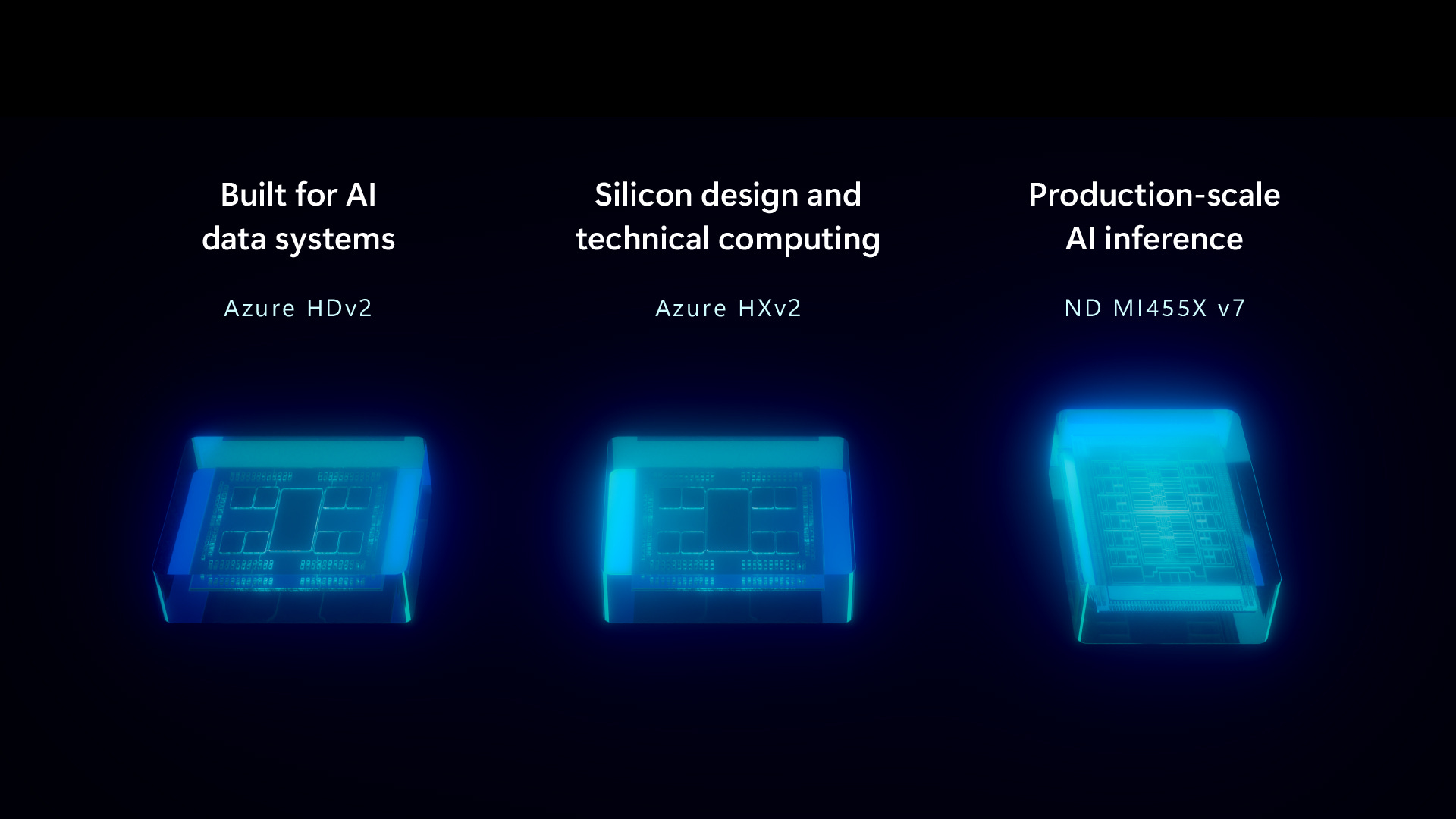
Microsoft’s expansion with AMD spans three distinct layers of the AI and high-performance computing (HPC) ecosystem:
Production-Scale AI Inference (
ND MI455X v7)Driven by AMD Helios: Integrates AMD Instinct MI455X GPUs, 6th Gen AMD EPYC (”Venice”) CPUs, Pensando networking, and the open ROCm software stack as a single rack-scale platform.
Target: Frontier-model inference, complex reasoning, real-time search, and autonomous agentic workflows.
AI Data Systems & Agent Coordination (
Azure HDv2)Hardware: Co-designed with AMD to eliminate CPU bottlenecks in data prep and pipeline orchestration. Features nearly 500 physical 6th Gen EPYC cores, 4 TB RAM, 32 TB NVMe storage, and 400 Gb Azure Boost networking.
Target: Mass agentic workload adoption, reinforcement learning, and high-density data pre-processing.
Silicon Design & Technical Computing (
Azure HXv2)Hardware: 176 6th Gen EPYC cores with 3D V-Cache running above 5 GHz, up to 4 TB RAM, and 800 Gb InfiniBand networking.
Target: Electronic Design Automation (EDA) simulation (optimized with Synopsys AI tools) and large-scale MPI-based scientific engineering.
Strategic Analysis: The Rack Is the New Unit of Compute
As AMD Head of Corporate Strategy and Partnerships M. Morale highlighted following the news, this deployment illustrates key changes in how enterprise AI infrastructure is evaluated:
1. From Training Hype to Inference Unit Economics
The broader AI market is rapidly shifting focus from the brute-force compute required for model training to the ongoing cost, power, and throughput dynamics of serving models at scale. When serving millions of agentic requests per second, efficiency across the entire hardware-software stack dictates margins.
2. Full-Stack Systems Over Individual Chips
AMD is no longer pitching discrete GPU or CPU comparisons against competitors. By delivering Helios—a rack-scale architecture spanning all four primary layers of the compute stack (GPU, CPU, networking, and software)—AMD is providing a turnkey, integrated building block for hyperscale clouds.
3. De-Risking the Supply Chain with Open Standards
For infrastructure architects, the joint deployment of AMD Helios inside Microsoft Azure proves that open, integrated platforms have reached production-ready maturity for frontier models. It provides enterprises and cloud providers with a high-performance alternative that mitigates single-vendor lock-in without sacrificing full-stack optimization.
Key Takeaways for Infrastructure Leaders
Heterogeneity is the standard: Hyperscalers are matching specific workloads (inference, EDA, data prep) to custom and partner silicon combinations rather than relying on a one-size-fits-all hardware stack.
CPU capacity matters more in the agentic era: The massive core counts of
HDv2demonstrate that agent coordination and data pipelines require heavily parallelized CPU power to keep accelerator GPUs fed.Architect for stack integration: When building or selecting cloud capacity, look at rack-level networking, memory bandwidth, and software integration (like ROCm/PyTorch compatibility) rather than raw GPU FLOPS alone.
 | A guest post by
|