Former FDA Commissioner on Pharmaceutical Resilience: Rebuild Trust Before the Next Drug Shock
How Taiwan could become the world’s trusted partner for high‑quality medicines, while helping resolve the weaknesses in the global pharma supply chain.
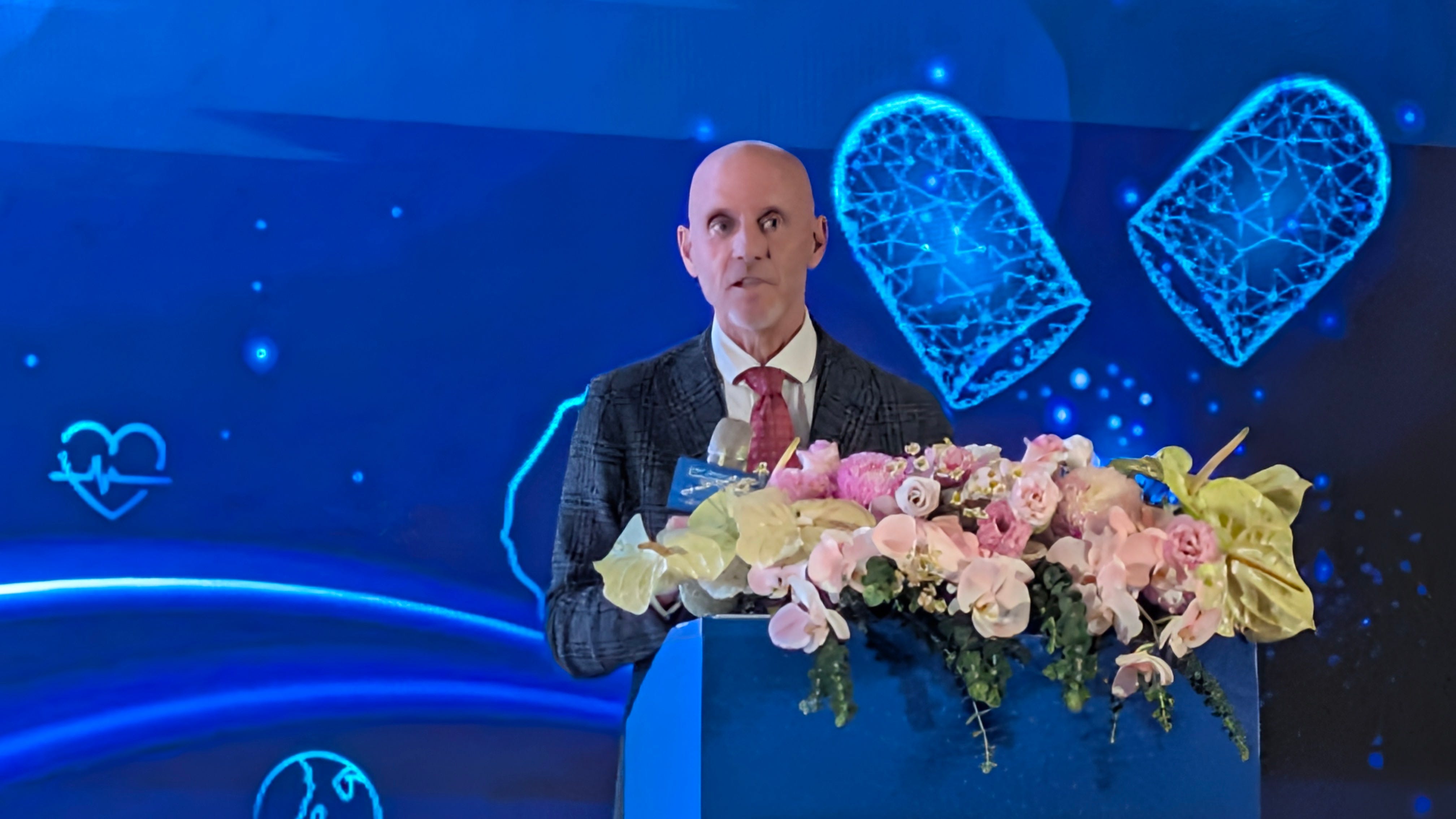
During his tenure as U.S. FDA Commissioner amid the COVID-19 pandemic, Dr. Stephen M. Hahn observed the precariousness of the global supply of critical medicines. Since then, pressures on the global drug supply have intensified.
A central question now emerges: Can Taiwan establish itself as a trusted global partner for high-quality medicines, paralleling its role in semiconductors?
“We (the U.S.) are most certainly not ready. We’re not ready for the next pandemic. We’re not ready for the next geopolitical disruption.”
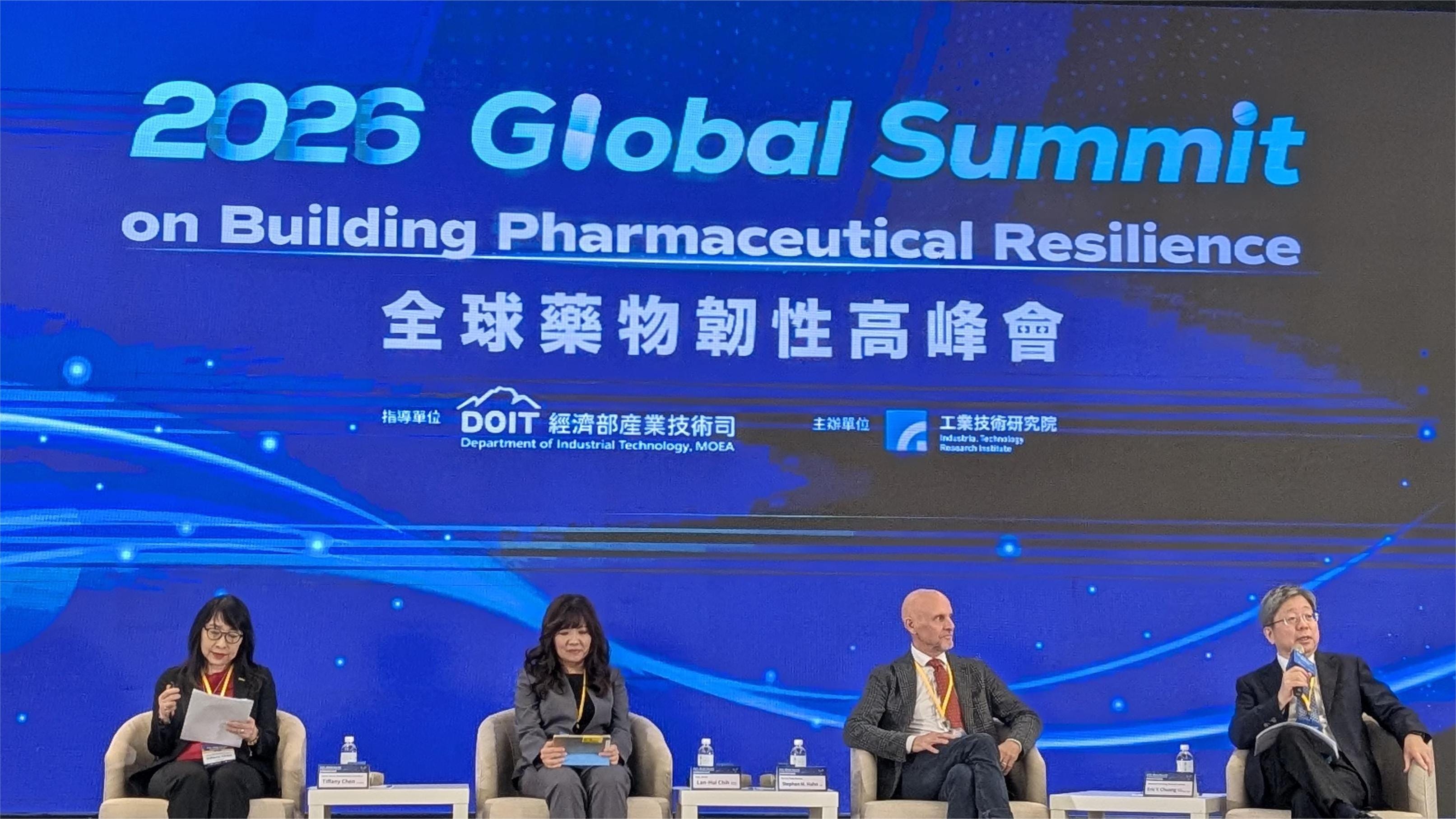
Speaking at the Global Summit on Building Pharmaceutical Resilience in Taipei on May 19, Hahn, now CEO of Nucleus RadioPharma, noted that the U.S. faces its highest level of active drug shortages since 2001 and remains unprepared for future shocks.
The COVID pandemic was a stress test, revealing the fragility of the global pharmaceutical system. New York City nearly exhausted its supply of propofol, a sedative essential for patients on ventilators. Shortages of vincristine, used to treat childhood leukemia, were particularly concerning.
Five years after COVID-19, Hahn says that “the structural risks in our pharmaceutical supply chain have grown. They haven’t decreased. They’ve gotten worse.”
“We are still not ready.”
Supply chain problems now affect every country, causing shortages of drugs, IV bags, respirators, and other critical medical supplies. At the same time, geopolitics and technology are reshaping the system's resilience.
Drug procurement is increasingly tied to national security as decoupling, friend-shoring, and export controls take hold. Meanwhile, advances in AI, continuous manufacturing, radiopharmaceuticals, mRNA platforms, and cell and gene therapy are rewriting the rules of how medicines are made.
Many of Hahn’s observations resonated with policymakers and industry leaders attending the summit, organized by the Industrial Technology Research Institute (ITRI).
Weak Spots
Hahn highlighted several critical weaknesses in today’s pharma supply chain:
● Dependence on China and India: About 80% of finished generic drugs used in the U.S. rely on Active Pharmaceutical Ingredients (APIs) or Key Starting Materials (KSMs) from these two countries.
● Single-source vulnerability: In some cases, a disproportionately large share of a common cancer drug has depended on a single manufacturer.
● Quality failures: About 70% of U.S. drug shortages stem from manufacturing quality problems rather than a lack of raw material.
● Other risks: Logistical bottlenecks, cyberattacks, geopolitical instability, and extreme weather events that can halt production.
To address these weaknesses before the next crisis, Hahn proposes several shifts in the pharmaceutical operating model, including:
● Advanced manufacturing: Continuous, modular production can boost efficiency, lower costs, shrink the environmental footprint, and improve quality.
● Onshoring and friend-shoring: Rebalancing production by onshoring critical medicines and APIs, or partnering with trusted allies, can better protect national health security while meeting global demand.
● Predictive monitoring: AI-driven models can anticipate shortages by linking manufacturing data to potential disruptions.
Friend-shoring – relocating supply chains to politically allied countries – has pushed manufacturing capacity to Mexico, Vietnam, Taiwan, and some EU countries on a limited scale. It is unclear if this is meaningful diversification or merely a symbolic relabeling exercise.
Hahn also sees new developments in oversight. “We will get to a world where in-person inspections are not necessary,” Hahn said. He envisions a future where greater transparency and real-time data sharing between manufacturers and regulators reduce the need for frequent FDA site visits.
The Taiwan Opportunity
Who will be trusted in the next crisis?
Hahn argues that Taiwan has a rare chance to become a global partner for high-quality medicines, echoing its rise in advanced chips. “What semiconductors took 30 years to build, biopharma can compress.”
With its world-class precision manufacturing and close ties to the U.S., Taiwan is well-positioned to deploy advanced manufacturing to build a more resilient and transparent pharma supply chain.
Hahn’s “Taiwan Opportunity” idea rests on existing strengths and pathways forward:
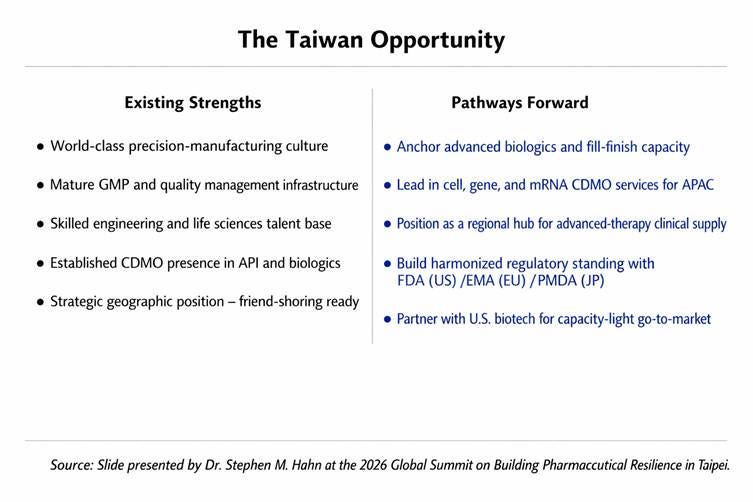
“Just as you (Taiwan) have become an incredibly important supplier of semiconductors and chips to us in the U.S. – very high-quality, high-level chips – the same can be true for generics and other drugs as well. We can actually do this together,” Hahn said.
Taking Quality Seriously
“There’s a growing concern in the U.S. about quality,” Hahn noted.
He thinks the quality issue, which covers both drug safety and efficacy, now drives much of the debate over generics and drugs more broadly. Taiwan’s strong regulatory oversight and close cooperation with the U.S. can help reassure both the American public and the government about the question: “Are we actually seeing quality manufacturing of drugs?”
That is a role he believes Taiwan can play not just for the U.S., but for the world.
Advanced, modular manufacturing is central to this vision. It underpins a proposed 2030 Resilient Pharma Operating Model, built on modular systems and a diversified geographic footprint. Hahn sees “great cooperation” between Taiwan and the U.S. as “most definitely possible” in this area.
One promising frontier is point-of-care radiopharmaceuticals and cell therapy manufacturing.
“When the medicine is the patient, the factory must move,” Hahn said. For cell therapies and radiopharmaceuticals, advanced manufacturing enables point-of-care production, moving the factory closer to patients and allowing on-demand fill-and-finish.
“Point-of-care manufacturing will be very important for some newer therapies. When I started in oncology, we never thought we should have a factory near MD Anderson Cancer Center or the University of Pennsylvania to manufacture cells with limited shelf life.”
Threats and Responses
So what keeps Hahn up at night now?
He warns that antimicrobial resistance is emerging as a major global health threat, one that will require new approaches beyond traditional antibiotics.
He also highlights growing vulnerabilities in digital and manufacturing infrastructure. Systems such as the U.S. FDA face tens of millions of cyber-intrusion attempts every day.
To prepare for the next shock, Hahn urges governments to maintain stockpiles of critical medicines, respirators, and personal protective equipment.
A core part of the needed “regulatory agility” is also speed.
While vaccines have typically taken about seven years to move from early trials to approval, agile regulators could aim for a 100-day goal by using rolling reviews and eliminating animal-based studies.
“I don’t think this is a fairy tale. I think it is imminently achievable,” Hahn said.
AI and digital infrastructure, in his view, now form the “resilience infrastructure.”
Digital platforms will be essential for proactive quality monitoring and predicting shortages. They can flag early signs of quality drift before recalls are triggered and slash technology transfer timelines from years to weeks. But human judgment must stay at the center to avoid over‑reliance on AI.
Redundancy as Investment
Another major threat to health security is the lack of redundancy.
True redundancy is not just about having another factory “a block down from the original site.” It requires a strategic approach that assesses infrastructure to ensure sufficient energy for backup sites. Selecting locations not exposed to the same weather events is also important. Hahn contends that the return on investment from building redundancy will be substantial.
Rebuilding Trust
When Hahn thinks about pharma resilience, he draws inspiration from COVID-era success stories. Common threads include: strong private-sector support, governments that backed science, and research that could be commercialized.
At the heart of all of this is trust. Hahn calls for a “public-private compact” in which the government provides financial incentives so that companies can invest in the redundancy needed to prevent future critical drug shortages.
Echoing many of the Taiwanese government and industry representatives at the summit, Hahn stressed the need to “rebuild trust in the U.S.”
“That trust has been severely broken with the public health community, and frankly, with globalization and in international relationships. And that needs to be rebuilt because we (the U.S.) cannot do it alone.”
For Hahn, Taiwan’s opportunity is not only to fix pharma supply chains but to help restore the trust that determines whether we are ready for the next crisis.
Editor’s note: Andrew Wang is the digital health correspondent for TechSoda. This article was first published on Andrew’s Substack.