
Profiles #1: German Game Developer Jennifer Schneidereit’s Entrepreneurial Journey
“What matters in popular culture right now is humanity—and AI doesn’t have that.”

What was the first time you played a video game? You may once have dreamed of becoming a game creator yourself—but what happened to that dream?
For Jennifer Schneidereit, co-founder and Creative Director of award-winning independent game studio Nyamyam, that dream began early and never let go. In an exclusive interview with TechSoda, she recalled the first time she encountered a computer and how it shaped her future.
Her father owned an Atari 800, which he used to solve complex engineering problems—but he also let Jennifer play games on it. “For some reason, and I can’t really tell you why, when I was six or seven years old, I thought, this is going to be the future,” she said. “I loved playing video games, and I thought, why don’t I become a game developer?”
Games, Family, and Early Support
Growing up in a large family, Jennifer was surrounded by play in many forms. Her relatives loved gathering around board games and card games during visits to her grandparents. Those shared experiences helped her recognize the social and emotional potential of games—something she later saw reflected in digital form.
Her father also encouraged her early curiosity. “When I told him I wanted to learn how to program, we tried a little bit together,” she said. “It wasn’t anything major, but he supported it—and that mattered.”
From Computer Science to Tokyo
Jennifer went on to major in computer science and, shortly after graduating, joined the Japanese game company Acquire in Tokyo. There, she gained hands-on experience managing projects, budgets, schedules, and financing—skills that would later prove essential.
In 2009, Jennifer relocated to the UK to work at Rare on the BAFTA award-winning Kinect launch title: Kinect Sports. In late 2010, Jennifer Schneidereit co-founded Nyamyam with Phil Tossell, a colleague while working on Kinect Sports at Rare. Nyamyam is an independent studio dedicated to creating beautifully crafted games.
She initially bootstrapped the company using her own savings. “It took me a long time to actively learn about business, programming, and game design,” she said, recalling how a friend later became her agent. “I knew how to design and make games, but raising funds is a completely different way of thinking.”
Investors, she learned, were less interested in design details and more focused on business logic: market fit, revenue potential, and returns. That realization pushed her to learn market analysis and to see the game industry through a broader commercial lens.
An Ultra-Marathon, Not a Sprint
While many developers treat game-making as a short, high-intensity sprint, Jennifer approaches it differently. She likens her career to an ultramarathon.
“Many people think they’ll make one great game, get rich, and that’s the end of the story,” she said. That mindset, she noted, contributes to why the average game development career lasts fewer than five years.
From the beginning, Jennifer saw the long-tail effect as the goal. “I knew I had to keep developing creatively with every game, but also get smarter about business, leadership, and managing people,” she said. “There are so many soft skills you have to learn along the way.” She also regularly reflects on past decisions and what she could have done better—a habit she considers essential to growth.
Tengami: Designing for a New Platform
Nyamyam’s first game, Tengami, was released in early 2011, just as touch-based gaming was emerging with the launch of the iPad. The game follows a man through 3D landscapes inspired by Japanese pop-up books, where progress depends on physically interacting with the environment.
The title stood out for its tactile design and artistic restraint, establishing Nyamyam’s identity as a studio interested in form, texture, and atmosphere—not spectacle alone.
Astrologaster: Comedy, History, and Care
Jennifer’s second game, Astrologaster, took a very different approach. A comedy based on the real-life 16th-century medical astrologer Simon Forman, the game was inspired by Forman’s medical records—the largest surviving medical database of the Renaissance.
“I was interested in exploring comedy in games,” Jennifer said. “So much of it is slapstick or immature. We wanted to see if we could do something closer to a sitcom.”
Developed in collaboration with an American professor teaching at the University of Cambridge, Astrologaster blended rigorous historical research with humor and musical storytelling. The result was another award-winning title.
Tengami and Astrologaster have won accolades recognizing excellence in art, audio, design, and narrative innovation, including:
Tengami -
Winner, Excellence in Audio, Visual Art and Design at the 11th International Mobile Gaming Awards (IMGA) in San Francisco, 2015;
Winner, Best Art at GameConnection in Paris, 2015;
Apple's worldwide "Editor's Choice" award upon iOS launch.
Astrologaster -
Excellence in Audio at the 22nd Annual Independent Games Festival (IGF) Awards.
Games as Interactive Cultural Inquiry
For Jennifer, originality matters more than imitation. “I’m not interested in being a copy artist,” she said. “I want to figure out what else games can do.”
With Astrologaster, that meant creating interactive entertainment that also functioned as cultural and historical exploration. Players experience what it was like to visit a doctor in 17th-century London, encountering patients from all walks of life—from royalty to ordinary citizens—and learning how they understood illness and the world around them.
The game also touches on serious social issues, including miscarriage—an experience rarely addressed in games. Jennifer believes this kind of thematic intentionality is unavoidable. “There is no such thing as value-neutral entertainment,” she said. “Everything we make exists within a social context.”
A Changing Industry and the Long Tail
Between the release of Tengami and Astrologaster, the industry shifted dramatically with the rise of free-to-play models. As a premium game developer, Jennifer found it increasingly difficult to persuade players to pay up front.
“Preparing for our next release in 2026, that challenge has only intensified,” she said. “The industry keeps changing, which means you have to keep learning and adapting. What worked for the last game won’t work for the next.”
For her, success isn’t just about launch day. “It’s about the long tail—ten, twenty, even forty years.”
Discovering Taiwan
Jennifer first visited Taiwan in 2023 to speak at a conference. She was struck by what she saw among local developers: a rare combination of strong artistic creativity and high technical competence.
“Having worked with developers around the world, that mix really stood out,” she said. “I remember thinking I’d love to collaborate with Taiwanese developers, even though I didn’t act on it immediately.”
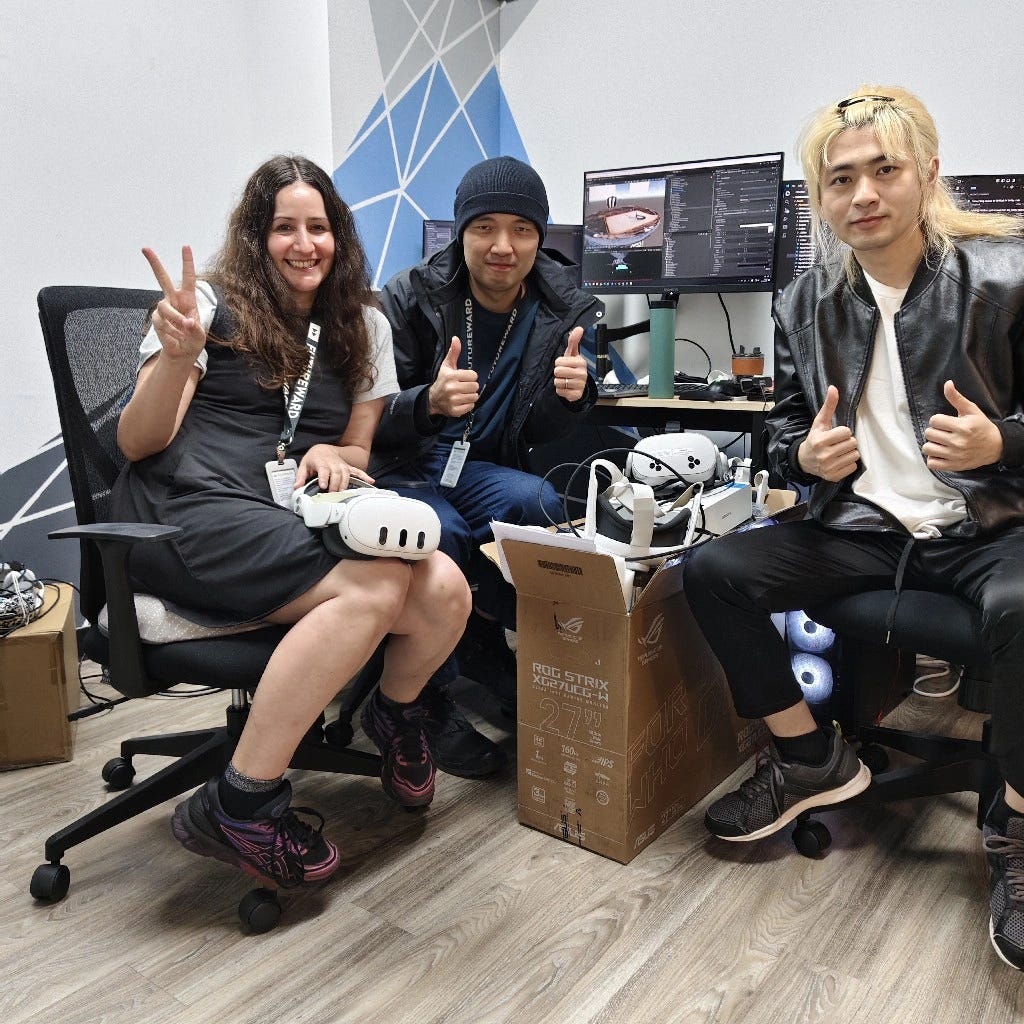
That opportunity came later, when she began developing a mixed-reality game that relies on volumetric capture. Taiwan—with government support, facilities like TAICCA’s IP Lab, and competitive costs—emerged as an ideal base. Around the same time, she secured a Taiwanese investor.
With funding, production support, and a growing personal connection to the country, relocating operations from London to Taiwan felt like a natural next step.
Living and Creating Across Cultures
“I think it’s an absolute privilege to live in another country and experience a culture so different from where I grew up,” Jennifer said, reflecting on her life in Taiwan and her earlier years in Germany.
She also noted regional differences within the Asian game industry. South Korea dominates large-scale online and MMO games, while Taiwan has built strength in independent development—an artistic and experimental space that can still achieve commercial success. Studios like Red Candle Games exemplify that potential.
Can Games Change the World?
Jennifer doesn’t believe a single game can change the world—but she does believe developers must be conscious of their cultural role.
“Changing the world isn’t my personal motivation,” she said. “But I’m very aware of what I put into my games. Dismissing games as ‘just entertainment’ is a cop-out.”
AI, Attention, and Humanity
While artificial intelligence is a major topic in the industry, Jennifer considers it overhyped in creative terms. She sees clear value in AI for process automation—speeding up and improving workflows—but not as a replacement for human expression.
Asked how games compete with platforms like TikTok for attention, she returned to first principles. “A good game values players’ time,” she said. “It delivers a deliberately crafted experience—whether that’s humorous, intelligent, or even uncomfortable. Filler rarely survives.”
What resonates most today, she believes, isn’t cinematic polish but humanity and personality. That’s why short-form social media works despite its simplicity—and why AI-generated content often feels shallow.
“Developers shouldn’t think in terms of competing for attention,” Jennifer said. “People move through different interests and cycles. The goal is simply to be meaningful and visible when the moment is right.”
Editor’s Note: Profiles are TechSoda’s exclusive interviews with outstanding thought leaders who excel in their respective fields.
With this inspiring interview, we wish all our readers a very fruitful, prosperous, and joyful New Year in 2026!