
Op-Ed: Navigating VUCA with Ancient Wisdom in the Year of the Fire Horse
Five Chinese ancient parables related to horses offer valuable insights for the world today
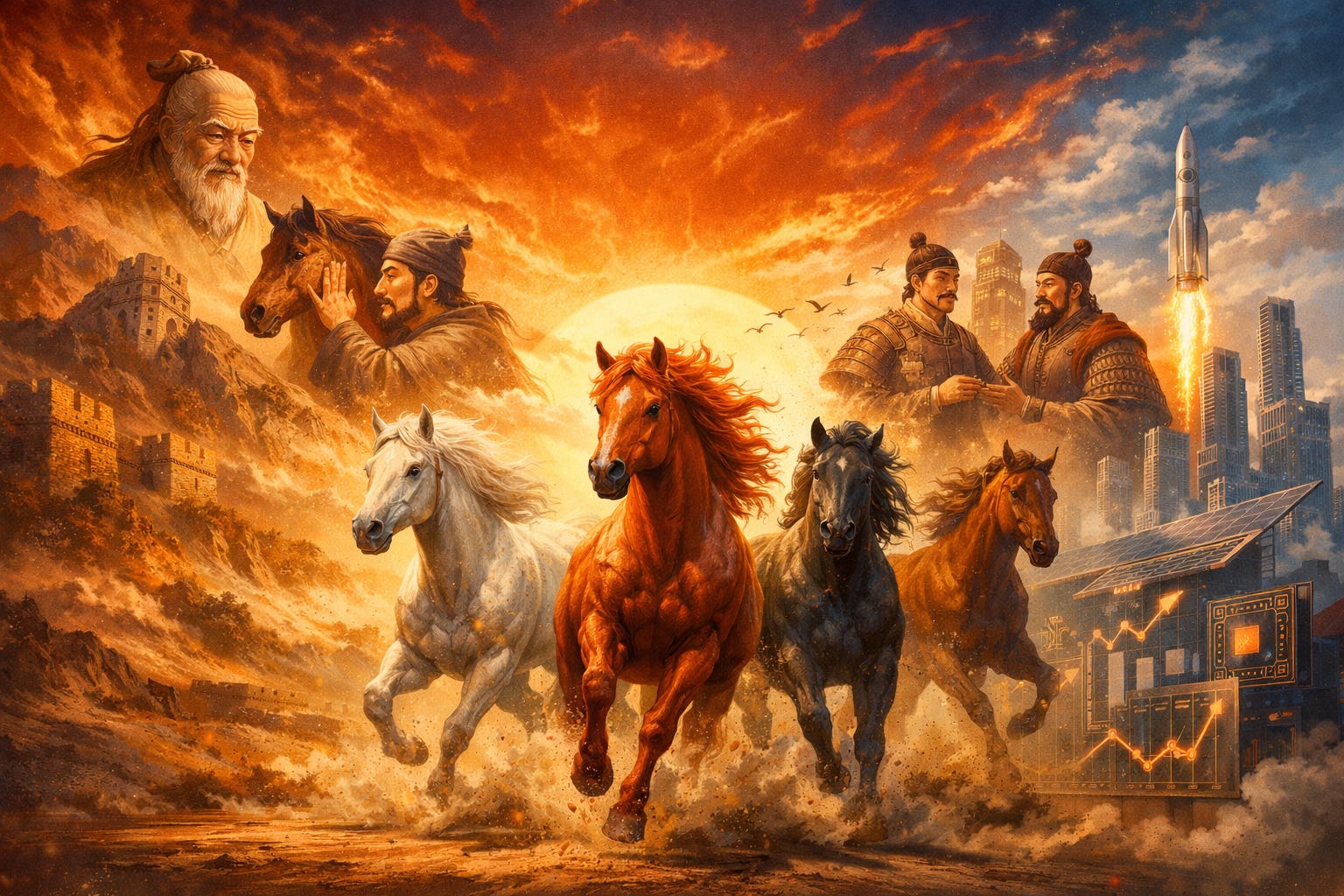
2026 marks the arrival of the Bing-Wu Year (丙午年), known in the Chinese sexagenary cycle as the Year of the Fire Horse. In traditional cosmology, Fire represents high-intensity energy and irreversible change, while the Horse symbolizes speed, ambition, and relentless competition. Sixty years ago, the previous Bing-Wu (Fire Horse) year coincided with the beginning of China’s decade-long Cultural Revolution.
In the context of today’s tech landscape—defined by AI breakthroughs, massive capital deployment, and geopolitical shifts—this ancient archetype feels remarkably modern. In a world where everyone is sprinting, speed is no longer your greatest advantage; running in the wrong direction is your greatest risk.
To navigate this volatility, we can look to five classic Chinese parables involving horses. These stories offer a timeless framework for decision-making in an age of high-speed uncertainty.
1. Sai Weng and His Lost Horse: Rethinking “Winning” and “Losing”
(Sài Wēng Shī Mǎ – 塞翁失馬)
The story tells of an old man living on the frontier who lost his horse. When neighbors offered condolences, he simply asked, “How do you know this isn’t a blessing?” Later, the horse returned with a magnificent stallion. When neighbors congratulated him, he remained calm. Later still, his son broke a leg while riding that stallion, yet this injury spared the son from being drafted into a deadly war.
The Lesson:
This isn’t just about optimism; it’s about the scale of time. Short-term fluctuations are deceptive.
Missing a hype cycle might save you from a “tech debt” trap.
Betting too early on a single architecture may become a liability.
A forced pivot today might be the foundation of your competitive edge tomorrow.
In the Fire Horse year, the rarest skill is not reaction speed, but psychological stability—the ability to remain unswayed by short-term market noise.
2. Bole and the Thousand-Mile Steed: The System of Talent
(Bó Lè Xiàng Mǎ – 伯樂相馬)
Bole was a legendary judge of horses. While others looked at a horse’s surface speed, Bole looked at bone structure, temperament, and performance under pressure. The saying goes: “Thousand-mile steeds (elite talents) are common, but a ‘Bole’ who can recognize them is rare.”
The Lesson:
In tech, the bottleneck isn’t just a lack of engineers or researchers; it is the lack of leaders who can identify and nurture latent potential. Many organizations fail not because they lack “steeds,” but because:
Talent is placed in the wrong roles.
KPIs only reward short-term, visible output.
The culture stifles non-mainstream ideas.
As we accelerate, ask yourself: Does your organizational “stable” allow the elite talents to survive, or are they being worked to death on mundane tasks?
3. General Yue Fei’s Discourse: Endurance Over Explosiveness
(Liáng Mǎ Duì – 良馬對)
The legendary General Yue Fei in the Song Dynasty once compared two types of horses. The “inferior” horse starts fast, eats anything, and pants with exhaustion after a short sprint. The “superior” horse is picky about its food (quality input), starts slow, but gains momentum. After running hundreds of miles, it arrives composed, as if it had done nothing.
The Lesson:
AI development is a marathon, not a 100-meter dash. A team that wins the battle would need both the warhorses, which can dash, and those that can travel far with logistics. In the AI era, true market leaders possess:
Selective Inputs: They don’t chase every trend; they focus on high-quality data and innovative talent.
Latent Power: They build robust infrastructures and financial discipline that can withstand “low-tide” periods.
The “Unsweating” Finish: They prioritize reliable, scalable delivery over flashy, one-off demos.
In 2026, don’t just build for the sprint; build for the “thousand-mile” journey.
4. Tian Ji’s Horse Racing: The Strategy of Asymmetry
(Tián Jì Sài Mǎ – 田忌賽馬)
General Tian Ji often lost races to the King because their horses were similar in strength. His strategist, Sun Bin, suggested a change in order: Pit your “inferior” horse against the King’s “superior” horse (a guaranteed loss), but then use your “superior” horse against his “middling” one, and your “middling” one against his “inferior” one. By losing one battle, Tian Ji won the war.
The Lesson:
Startups and SMEs cannot outspend tech giants on raw compute or headcount. Success comes from Battlefield Selection.
Don’t compete head-on where the giant is strongest.
Reallocate resources to niche applications or “non-asymmetric” fields.
Be willing to sacrifice a traditional metric to win a future market.
5. The Old Horse Knows the Way: The Value of Experience
(Lǎo Mǎ Shí Tú – 老馬識途)
An ancient army once found itself lost in a trackless wasteland. The commander followed the lead of an old horse, trusting that its memory would find the path home. The old horse wasn’t the fastest, but it knew which paths led to dead ends.
The Lesson:
In an era of rapid iteration, “experience” is often dismissed. However, seasoned veterans provide essential wisdom for risk management. They know:
Which hypes will eventually fizzle out.
Which bottlenecks cannot be solved by “working harder.”
When to stop, when to pivot, and when to endure.
Speed is vital in the Year of the Fire Horse, but the “Old Horse” (experience) is what prevents you from running off a cliff.
Conclusion: Endurance is the Ultimate Speed
The Year of the Fire Horse will be a time of intense competition. Capital, technology, and talent will flow faster than ever. But history teaches us that the winners of such cycles are not the most impulsive, but the most clear-headed.
In 2026, may you maintain your judgment amidst the chaos, use your resources with the wisdom of a strategist, and lead your team with the endurance to finish the long race.
Read the original essay in Mandarin:
