
Global Market Watch: TSMC and Intel Push CoPoS Glass Substrate Packaging Toward Commercialization
TSMC and Intel are advancing CoPoS (Chip-on-Panel-on-Substrate) glass substrate packaging; Intel’s EMIB-T advanced packaging yield has reportedly climbed above 90%, targeting mass production in 2027 at roughly half the cost of TSMC’s CoWoS. Alibaba released Qwen3.8-Max, a 2.4 trillion-parameter model it calls the strongest in the Qwen family, with open weights expected next week. Taiwan’s Han Kuang exercise, running August 5-14, will expand simulated drone warfare and swarm-attack countermeasures.
I. Semiconductors
1. TSMC and Intel Push CoPoS Glass Substrate Packaging Toward Commercialization, Lifting Taiwan Equipment Makers
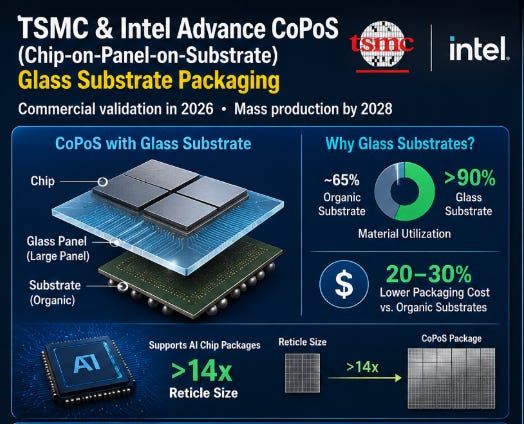
The story: TSMC and Intel are advancing CoPoS (Chip-on-Panel-on-Substrate) glass substrate packaging, with commercial validation expected in 2026 and mass production by 2028.
Key numbers: Glass substrates lift material utilization from around 65% to over 90% and cut packaging costs 20-30% versus organic substrates, supporting AI chip packages over 14 times reticle size.
Why it matters: Grand Plastics (2340.TW) benefits on TGV wet-process equipment, Wanrun (6187.TW) on large-panel automation, and Chun Hua (6813.TW) on precision bonding. All three gain exposure before CoPoS even reaches chipmakers’ P&L.
2. Intel’s EMIB-T Packaging Claims 50% Lower Cost Than TSMC’s CoWoS, Wins a MediaTek Order
The story: Intel’s EMIB-T advanced packaging yield has reportedly climbed above 90%, targeting mass production in 2027 at roughly half the cost of TSMC’s CoWoS. Intel has won a MediaTek ASIC order, with Broadcom and Meta said to be evaluating.
Key numbers: EMIB-T uses a small silicon bridge for die-to-die connections instead of a large silicon interposer. TSMC’s CoWoS interposer runs up to 3.3 times reticle size, and its CoWoS-L variant reaches 3.5 times.
Why it matters: PSMC (6770.TW) is Intel’s sole silicon capacitor supplier for EMIB-T, with capacity already fully booked. UMC (2303.TW) is the foundry partner for EMIB-T’s silicon bridge component, giving Taiwan’s packaging chain a second platform beyond CoWoS.
3. PSMC Confirms Leadership Continuity After Founder Frank Huang’s Death
The story: PSMC (6770.TW) held a press conference on August 4 to confirm its strategy and core team remain unchanged following founder Frank Huang’s death, with the company continuing his existing roadmap under Vice Chairman Steve Hsieh as acting chairman.
Key numbers: Strategy stays fixed on legacy nodes, specialty processes, AI chips, 3D AI Foundry, and HBM, alongside continued interposer and silicon capacitor (Si-Cap) packaging development and its existing Micron memory partnership. Huang held 2.96 million shares (1.82% stake) as PSMC’s eighth-largest shareholder as of March 2026.
Why it matters: This confirms no near-term disruption to PSMC’s role as Intel’s sole silicon capacitor supplier or its interposer capacity plans, both of which Taiwan’s advanced packaging chain, including UMC’s planned 2027 interposer capacity handoff, is already counting on.
II. Artificial Intelligence
1. Alibaba’s Qwen3.8-Max Joins China’s Race Past the 2-Trillion-Parameter Mark
The story: Alibaba released Qwen3.8-Max, a 2.4 trillion-parameter model it calls the strongest in the Qwen family, with open weights expected next week. Benchmarks show its coding and AI agent capabilities approaching Anthropic’s Fable 5.
Key numbers: Qwen3.8-Max ranks fourth globally on Arena.ai’s Frontend Code Arena, behind Claude Opus 5 Max and Kimi K3 Max. Its API pricing runs roughly 40% and 24% of Opus 5’s input and output rates. OpenRouter’s latest weekly usage ranking shows all top five most-used AI models are now Chinese-developed.
Why it matters: China’s AI race has moved past chasing raw scale and into competing on cost-efficiency and usage share. With the top five most-used models globally now Chinese and priced well below Western equivalents, this pricing pressure looks like a pattern across the whole Chinese AI industry.
2. DeepSeek’s V4-Flash Pushes Inference Pricing Low Enough to Force an OpenAI Price Cut
The story: Artificial Analysis benchmarks show DeepSeek’s V4-Flash running at the lowest cost among major models, under 1% of Claude Fable 5’s cost per test. Reuters says the pricing has pressured OpenAI to cut GPT-5.6 Luna’s price 80% in late July.
Key numbers: V4-Flash charges $0.14 per million input tokens and $0.28 per million output, averaging 3 cents per benchmark test versus Kimi K3’s 86 cents and Claude Fable 5’s $3.15. It scored 50 on Artificial Analysis’s intelligence index, below Kimi K3’s 57.
Why it matters: V4-Flash wins on cost per unit of output rather than raw capability, a different axis than the benchmark race Qwen3.8-Max and Kimi K3 are running. An 80% OpenAI price cut in response shows this pressure now reaches Western labs, extending well beyond China’s own developer market.
3. Toughtek Partners AMD and TWSC on AI Edge Computing Box for Enterprise AI Agents
The story: Toughtek (7710.TW) teamed with AMD and Taiwan Web Service Corp (7735.TW) to launch the AI BOX-A395, an edge AI computing solution combining hardware and inference for enterprise AI agent applications.
Key numbers: The device runs AMD’s Ryzen AI Max+395 processor, delivering up to 126 TOPS and supporting up to 128GB memory for on-premise LLM deployment. Toughtek’s H1 net profit hit a record NT$267M, up 198.7% year-over-year.
Why it matters: Running LLMs on-premise addresses data governance concerns cloud APIs can’t solve for regulated industries. Toughtek’s earnings growth suggests this demand is already converting into real orders rather than staying stuck at the pilot stage.
III. Drones & Defense
1. Taiwan’s Han Kuang Exercise Expands Drone Attack-and-Defense Simulation as NSC Warns of Hybrid Threats
The story: Taiwan’s Han Kuang exercise, running August 5-14, will expand simulated drone warfare and swarm-attack countermeasures. NSC Secretary-General Wu Jaushieh separately warned China’s coercion has escalated into hybrid warfare spanning economic, information, and AI-enabled cyber threats.
Key numbers: Taiwan’s defense ministry is procuring MQ-9B drones, loitering munitions, and small suicide drones, budgeting roughly NT$210-330 billion for drone programs through 2031, still pending legislative review.
Why it matters: Expanding drone countermeasures in Han Kuang signals the military is treating drone warfare as a near-term reality, drawing on lessons from Ukraine. Wu’s hybrid-warfare framing adds pressure on lawmakers to move faster on the stalled drone budget.
2. Opposition Lawmakers Visit NCSIST’s Drone Tech, Signal Support for Restoring Cut Budget Items
The story: KMT and TPP legislators toured NCSIST’s self-developed “Jinfeng” drone and Taichung’s drone industry cluster on August 4, coming away impressed. Legislator Hung Yu-hsiang said his party would help push to restore drone budget items his own caucus previously proposed cutting.
Key numbers: Taichung’s drone industry output already tops NT$10B. NCSIST showcased its Jinfeng drones alongside a joint anti-armor loitering munition developed with US firm Kratos, already in domestic mass production.
Why it matters: Lawmakers endorsing the technology firsthand adds political cover to pass the still-stalled drone budget, since opposition legislators are now the ones calling for funding to move forward.
3. Japanese Drone Startups Race to Cut China’s Grip on Japan’s Industrial Drone Market
The story: Japanese drone makers including Terra Drone, Prodrone, and Eams Robotics are pushing into military drones as PM Takaichi’s government targets cutting China’s dominance of Japan’s industrial drone supply. Prodrone partnered with Toshiba on interceptor drones backed by Japan’s policy investment bank.
Key numbers: China holds 91% of Japan’s industrial drone market; Japan wants domestic share up from 3% in 2025 to over 50% by 2030, targeting 80,000 domestically produced military drones.
Why it matters: Japan’s push to displace Chinese suppliers mirrors Taiwan’s own non-red supply chain drone strategy, both racing to build domestic capacity before reliance becomes a wartime vulnerability.
IV. Robotics & Industrial Automation
1. Chinese Ed-Tech Firm Launches Embodied AI Robotics Training Program, Enrollment Already Full
The story: Chuanzhi Education launched an “AI Embodied Intelligence Robot” curriculum, with its first cohort fully enrolled ahead of an October start, partnering with robot makers AgiBot, Zhongqing, and Realman.
Key numbers: The program follows a theory-simulation-real-machine loop covering industrial arms, quadrupeds, and humanoids, with 70% of coursework built around real deployed projects.
Why it matters: A training cohort filling before launch is a labor-market signal as much as a manufacturing one, pointing to real hiring demand building up behind China’s robot makers.
2. China’s Embodied AI Funding Frenzy: Four Robotics Startups Close Rounds in a Single Day
The story: Ahead of Unitree’s imminent IPO at a reported RMB42B valuation, four Chinese robotics companies announced funding on August 3 alone, including DISCOVER Robotics’ second $100M+ round in under a month and home robot startup PokeBot’s nine-figure Pre-A round.
Key numbers: One investor said firms already valued above RMB20B are largely off their radar now that Unitree’s IPO sets a market benchmark. PokeBot demonstrated a robot autonomously cooking a full dish and plans its first product priced from roughly RMB10,000.
Why it matters: Investors say embodied AI has shifted from technology breakthroughs to a scaling phase, with companies lacking real commercial deployment now facing a much harder funding environment.
3. South Korean Researchers Pair Drone Maps with Ground LiDAR to Fix Orchard Robot Drift
The story: Chonnam National University researchers developed an AI mapping method combining drone maps with ground LiDAR, helping orchard robots correct positioning errors caused by tree canopy blocking satellite signals.
Key numbers: Testing over roughly 1.3km of orchard travel showed localization errors in centimeters, with less drift than conventional methods, validated across seasonal foliage changes.
Why it matters: Canopy interference has limited precision farming robots to shorter, supervised routes. A reliable fix could extend autonomous operation across larger orchards, a building block other Asia-Pacific agtech developers will watch closely.
V. AI Policy & Geopolitics
1. Taiwan’s Premier Pledges Deeper Japan Chip R&D Ties as TSMC’s Kumamoto Fab Reaches Break-Even
The story: Premier Cho Jung-tai told the Taiwan-Japan Semiconductor Technology Forum that Taiwan and Japan are “lips and teeth” on semiconductors, pledging deeper joint R&D. Economic Minister Kung Ming-hsin confirmed TSMC’s first Kumamoto fab has reached break-even, with a second fab under construction.
Key numbers: The forum drew Taiwan and Japan semiconductor associations alongside suppliers including TSMC, Realtek, and AUO. Cho pointed to Taiwan’s ten key AI infrastructure projects as part of next year’s budget priorities.
Why it matters: A break-even Kumamoto fab, reached faster than expected even after July’s earthquake, strengthens the case for deeper Taiwan-Japan cooperation on materials, equipment, and talent, the next phase beyond fab construction itself.
2. Taiwan’s Labor Pension Fund Keeps AI and Electronics Stocks as Its Core Holdings
The story: Taiwan’s Bureau of Labor Funds disclosed its top 10 H1 2026 holdings, with officials calling AI a decade-long structural trend rather than a short-term theme.
Key numbers: Top holdings are TSMC (29.33%), MediaTek (7.74%), Delta Electronics (6.31%), Elite Material (3.92%), Unimicron (3.32%), and ASE Technology (2.43%).
Why it matters: Officials say the approach stays anchored to fundamentals over short-term volatility. TSMC’s weighting eased 2.63 points from year-end, suggesting the portfolio is diversifying further into the broader AI supply chain rather than concentrating further.
3. Taiwan Launches NT$5M Competition to Draw International AI Startups Onto Its New Innovation Board
The story: Taiwan’s FSC and National Development Council launched “TiBOOST,” a competition inviting AI startups worldwide to compete for a spot on the Taiwan Innovation Board, part of the push to build an “Asian Nasdaq.”
Key numbers: Applications run through September 29, with finals November 10. Total prize money is NT$5M across the top three teams, targeting AI applications, fintech, silicon photonics, and quantum tech.
Why it matters: Taiwan is explicitly recruiting AI startups from abroad to list locally, extending its “Asian Nasdaq” ambitions beyond the domestic capital it already has through TSMC and its supply chain.
Global Market Watch is a daily market intelligence report produced in collaboration between TechSoda and FCC Partners, a Taiwan-based investment bank. We curate and analyze the latest developments across AI, semiconductors, drones & defense, robotics & industrial automation, and policy & geopolitics to keep you informed of the trends shaping global markets.
Disclaimer: Any discussion of stock prices, market performance, or specific companies in this article is provided solely for informational and educational purposes. It should not be construed as investment, financial, or trading advice, nor as a recommendation to buy, sell, or hold any securities. Readers should conduct their own research and consult a qualified financial adviser before making any investment decisions.