
Global Market Watch: CXMT Surges Nearly 5 Fold on IPO
I. Semiconductors
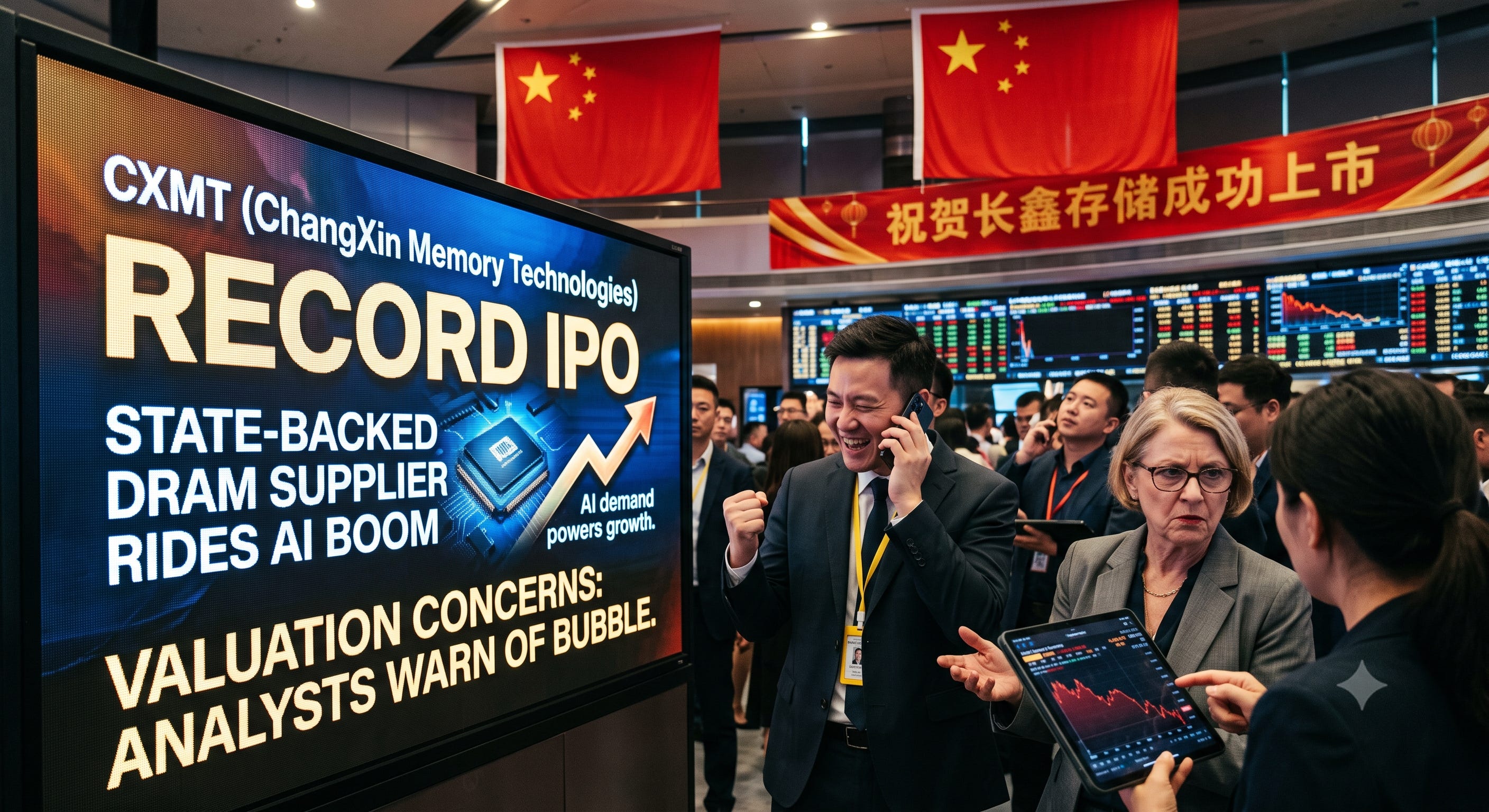
1. CXMT Lists at Record $9.2B, Targeting the Standard DRAM Market
CXMT completed the largest IPO in Asia this year and the biggest ever on Shanghai’s STAR Market on July 27, raising fresh capital to accelerate its expansion in standard DRAM production. The listing comes as Samsung, SK Hynix, and Micron continue shifting manufacturing capacity toward HBM, creating an opening in commodity memory.
What happened
CXMT debuted at RMB 49.50 per share after pricing its IPO at RMB 8.66, briefly valuing the company at RMB 3.31 trillion and making it China’s most valuable listed company. The company expects to become profitable for the first time in the first half of 2026 while expanding monthly wafer capacity toward Micron’s scale.
Key numbers
IPO: RMB 66.6B raised (with greenshoe) | Valuation: RMB 3.31T at market open | Capacity: 300,000–380,000 wafers/month target | Forecast: H1 revenue RMB 110–120B; net profit RMB 50–57B
Why it matters
The opportunity CXMT is pursuing is structural rather than cyclical. As the three global DRAM leaders prioritize HBM for AI servers, supply of conventional DDR5 and LPDDR5X remains relatively constrained. CXMT’s expansion directly targets that segment, increasing competitive pressure on Taiwan’s Nanya Technology and Winbond, whose businesses remain concentrated in standard DRAM. As China’s domestic champion approaches Micron-scale capacity with a protected home market, pricing power in commodity memory is likely to weaken over the long term.
2. Taiwan’s Semiconductor Fabs Will Claim One-Third of the Island’s Electricity by 2035
Taipei, July 2026. Taiwan’s semiconductor industry is projected to consume more than 30% of the country’s electricity by 2035, underscoring how power infrastructure is becoming as strategically important as fab construction in supporting the next wave of AI-driven manufacturing.
The story
According to Taipower’s internal projections and the Ministry of Economic Affairs’ latest national energy report, electricity demand from Taiwan’s semiconductor sector will more than double over the next decade as advanced foundries, HBM memory, advanced packaging, and AI server production continue to expand. While Taiwan’s semiconductor manufacturing footprint will remain overwhelmingly domestic, the pace of fab construction is increasingly testing the country’s ability to deliver sufficient power infrastructure.
Key numbers
Power demand: 52B kWh (2026) → 80B kWh (2030) → 110B kWh (2035)
Share of Taiwan’s electricity: 17.7% → 24.3% → 30.4%
Manufacturing footprint: 83% of Taiwan’s semiconductor capacity remains onshore today, easing only to about 79% by 2030
TSMC expansion: 19 fabs in operation, with another 13 under construction across Hsinchu, Taichung, Chiayi, Tainan, and Kaohsiung
Why it matters
The challenge is no longer demand for semiconductor capacity but the infrastructure required to support it. Taipower’s chairman recently noted that some companies are acquiring existing industrial buildings and upgrading equipment instead of waiting for new grid connections, highlighting how electricity availability has become a critical execution bottleneck. For investors, this shifts attention beyond semiconductor manufacturing toward the broader AI infrastructure ecosystem—including power distribution, grid modernization, thermal management, and energy systems—which is emerging as a multi-year capital expenditure theme alongside chip production.
II. Artificial Intelligence
1. Taiwan’s IPC Leaders Post 50–140% Revenue Growth as Edge AI Moves into Deployment
Taipei, July 29. Taiwan’s industrial PC (IPC) makers are reporting another month of exceptional revenue growth, suggesting that enterprise adoption of Edge AI is expanding beyond pilot projects into broader commercial deployment.
The story
June revenue results show strong momentum across Taiwan’s IPC sector, with growth extending well beyond industry leaders Advantech and Ennoconn to smaller manufacturers. The broad-based acceleration reflects increasing demand for AI computing at the edge, where enterprises are deploying inference workloads locally in factories, hospitals, retail stores, and transportation systems. As AI applications migrate from centralized cloud infrastructure to distributed devices, IPC vendors are evolving from hardware suppliers into platform providers offering integrated software and AI services.
Key numbers
Sector leaders: Ennoconn revenue +57% YoY to NT$17.66B (backlog exceeds NT$25B); Advantech +73.4% YoY to NT$10.12B
Fastest grower: Guangji +143.6% YoY, leading the sector in June
Broad participation: Weiqiang +80% YoY; AAEON (Yantek) +47.1% YoY
Market outlook: Global IPC market projected to grow from US$63.6B in 2026 to US$103.5B by 2035 (5.5% CAGR)
Why it matters
The strength of June’s results suggests that Edge AI demand is becoming broad-based rather than concentrated in a handful of market leaders. Unlike cloud AI, enterprise edge deployments require dedicated on-premise computing platforms capable of delivering low-latency inference, creating sustained demand for industrial PCs. At the same time, leading vendors such as Advantech and Ennoconn are shifting toward software-enabled platform models through WISE-PaaS and Xperon, respectively. The next phase of competition will hinge less on hardware shipments and more on their ability to expand recurring software and services revenue while preserving margins as the hardware cycle matures.
2. NVIDIA Reaffirms AI Demand as Quanta and Foxconn Extend Their Leadership
NVIDIA says demand for AI infrastructure remains robust, with shipments of its next-generation GB300 systems ramping and Rubin chips entering production. The latest commentary reinforces Taiwan’s leading role in the global AI server supply chain as hyperscalers continue expanding their data center investments.
The story
Speaking at a closed-door meeting hosted by Morgan Stanley, NVIDIA highlighted sustained demand across its AI product portfolio, including a rapidly growing CPU business expected to become a meaningful revenue contributor in 2026. The company also confirmed that GB300 AI server shipments are ramping through Quanta and Foxconn, while Rubin chips have entered production. Despite the growing adoption of custom AI accelerators by major cloud providers, NVIDIA noted that GPUs continue to account for roughly half of compute deployment even among customers developing their own ASICs.
Key numbers
New growth engine: NVIDIA CPU business expected to contribute about US$20B in 2026 revenue
Production: GB300 cabinet shipments ramping; Rubin chips now shipping
Customer mix: Large CSPs represent about 50% of NVIDIA’s data center business, with GPUs still accounting for roughly half of compute deployment even alongside in-house ASICs
Taiwan ODMs: Quanta has AI order visibility through 2027–2028 and plans three additional U.S. production sites; Foxconn maintains more than 40% global AI server market share while expanding capacity
Why it matters
NVIDIA’s latest comments reinforce that GPUs and custom ASICs are becoming complementary rather than competing architectures. GPUs remain the preferred platform for large-scale AI training and general-purpose workloads, while ASICs increasingly handle specialized inference tasks where cost and efficiency matter most. For Taiwan’s ODMs, Quanta’s multi-year order visibility and Foxconn’s continued capacity expansion suggest that AI infrastructure spending remains a long-term buildout rather than a single-product upgrade cycle, preserving Taiwan’s strategic position at the center of global AI server manufacturing.
3. Delta Electronics Locks in US$2B SiC Supply Deal as AI Data Center Power Demand Accelerates
July 30. Delta Electronics has reportedly signed a long-term supply agreement worth about US$2 billion with Infineon for silicon carbide (SiC) and other critical power components, positioning itself for the next generation of ultra-high-power AI data centers.
The story
According to market sources, the agreement marks Delta’s first major long-term component supply contract since the pandemic and comes as AI server power requirements continue rising at an unprecedented pace. NVIDIA’s Vera Rubin platform is expected to push rack power consumption beyond 500kW, with future AI cabinets approaching 1MW. The transition from traditional AC power distribution toward 400VDC and eventually 800VDC architectures will significantly increase demand for SiC-based power electronics and accelerate adoption of next-generation power management technologies such as solid-state transformers.
Key numbers
Supply agreement: Approximately US$2B (NT$65B) long-term contract with Infineon
Power density: AI rack power rising from about 20kW in 2022 to more than 500kW with Vera Rubin, with future systems approaching 1MW
Technology shift: Data center power architecture evolving from AC to 400VDC and ultimately 800VDC
Next milestone: Delta expects solid-state transformer adoption to reach an inflection point by 2027
Why it matters
The rapid increase in AI power density is reshaping the economics of data center infrastructure. As rack-level power climbs toward the megawatt range, conventional silicon-based power devices face growing efficiency and thermal constraints, making SiC an enabling technology rather than a premium option. Delta’s decision to secure long-term supply today signals confidence that 800VDC architectures are moving from concept to deployment. Beyond semiconductors, the transition creates a multi-year investment cycle across power conversion, cooling, and intelligent grid technologies, with solid-state transformers emerging as a key building block for future AI data centers.
III. Drones & Defense
1. Taiwan’s Drone Exports Triple to US$212M in Six Months as Indigenous Programs Gain Momentum
Late July. Taiwan’s drone industry is rapidly expanding its international presence, with exports surpassing the country’s full-year 2025 total in just six months while its flagship Teng Yun unmanned aerial vehicle completes combat evaluation for potential military procurement.
The story
Taiwan Customs data show drone exports accelerating sharply as overseas demand broadens beyond Europe to include new markets such as Saudi Arabia. At the same time, the National Chung-Shan Institute of Science and Technology (NCSIST) has completed combat evaluation of its Teng Yun UAV, paving the way for possible procurement by Taiwan’s Air Force alongside U.S.-made MQ-9B drones. The combination of rising exports and advancing indigenous capabilities reflects a maturing domestic drone ecosystem serving both commercial and defense markets.
Key numbers
Export growth: US$4.4M (2024) → US$93.4M (2025) → US$212M in H1 2026
New market: Saudi Arabia imported US$47.2M of Taiwan-made drones in June, a monthly record
Export destinations: Czech Republic, Poland, and the United States accounted for more than 90% of 2025 exports
Defense milestone: Teng Yun has completed combat evaluation and is under consideration for Air Force procurement, with electronic warfare capabilities planned for future upgrades
Why it matters
Taiwan’s drone industry is moving from niche exports toward sustained international growth, supported by both commercial demand and domestic defense investment. Saudi Arabia’s emergence as a major customer suggests Taiwan is beginning to diversify beyond NATO-related markets, although China’s US$3.1 billion drone exports remain roughly 30 times larger. Teng Yun’s successful combat evaluation also strengthens the credibility of Taiwan’s indigenous defense ecosystem, while the proposed NT$2.1–2.4 trillion special defense budget could accelerate industrial scale and improve competitiveness before Chinese suppliers further consolidate global market share.
2. Thunder Tiger Advances in U.S. Military Drone Program as Taiwan Deepens Ukraine Supply Chain
July 2026. Taiwan’s Thunder Tiger has advanced to the second phase of the Pentagon’s Drone Dominance Program, while new evidence shows Ukrainian drone manufacturers are already sourcing critical components from Taiwanese suppliers.
The story
Thunder Tiger, working with Farage Precision, secured an initial U.S. military order under the Pentagon’s Drone Dominance Program and has qualified for the more demanding second phase of the competition. Separately, Taiwan External Trade Development Council (TAITRA) Chairman Huang Chih-fang’s visit to Ukraine highlighted Taiwan’s growing role in supplying batteries, motors, flight control chips, and airframes to Ukrainian drone manufacturers, demonstrating that Taiwan has become an increasingly important link in the global drone supply chain.
Key numbers
U.S. program: US$1.1B Drone Dominance Program targeting 200,000 small military drones
Thunder Tiger: Ranked 11th among 26 competitors, winning an initial order for 1,520 drones worth about US$8M
Phase 2: Range requirement doubles to 20km with added indoor night-vision capability; results due August 2026
Ukraine: Seven of 61 Ukrainian Drone Industry Association members publicly source key drone components from Taiwan
Why it matters
Thunder Tiger’s progress represents more than a successful bid—it demonstrates Taiwan’s ability to compete in one of the world’s most demanding military procurement programs. Equally important, Ukraine’s reliance on Taiwanese components confirms that Taiwan has already established itself within the international drone supply chain rather than merely seeking future opportunities. The next challenge will be technological execution: meeting the Pentagon’s more demanding Phase 2 performance requirements will determine which Taiwanese manufacturers can translate early commercial success into sustained participation in global defense markets.
IV. Robotics & Industrial Automation
1. AMD Expands into Physical AI with Kria Platform, Naming Taiwan Partners
Late July. AMD is broadening its AI strategy beyond data centers with the launch of its Kria AI platform and an open Robotics Partner Network, positioning Taiwan’s Weiqiang and Ubiqconn (友上科技) among the early ecosystem partners for next-generation intelligent machines.
The story
Announced at the Advancing AI 2026 conference, the Kria AI platform combines CPU, GPU, NPU, and FPGA technologies into a single embedded computing platform designed for robotics and other edge AI applications. AMD is also building an open Robotics Partner Network that brings together hardware manufacturers, software developers, sensor suppliers, system integrators, and simulation companies around a common hardware architecture and open software standards. Engineering samples are now available, with ODM volume production scheduled to begin in the fourth quarter of 2026.
Key numbers
Integrated platform: Ryzen AI Embedded X100 combines CPU, GPU, NPU, and FPGA in a single system-on-module
Open ecosystem: Robotics Partner Network spans ODMs, ISVs, simulation, sensors, safety, and system integration partners
Taiwan participation: Weiqiang and Ubiqconn are among the named ecosystem partners
Commercial timeline: ODM volume production targeted for Q4 2026
Why it matters
Physical AI requires real-time perception, inference, and control at the edge, where cloud connectivity cannot always be guaranteed. While NVIDIA’s Isaac platform remains the industry’s most mature robotics ecosystem, AMD is pursuing a different strategy by building an open partner network that lowers barriers for hardware and software vendors. For Taiwan’s industrial computing companies, early participation in AMD’s ecosystem offers more than branding—it provides an opportunity to secure design wins and certification status as robotics platforms become increasingly standardized across manufacturing, logistics, healthcare, and autonomous systems.
2. Tainan Builds an Integrated Robotics Hub While Expanding into European Markets
Late July. Tainan is pairing long-term industrial development with overseas market expansion, establishing a three-cluster robotics ecosystem while sending local drone companies to Poland to pursue new business opportunities.
The story
Led by Mayor Huang Wei-che, a delegation of six Taiwanese companies visited Poland and signed a memorandum of understanding with Gdańsk in northern Poland to strengthen cooperation in drones and smart manufacturing. The overseas outreach comes as Tainan builds an integrated robotics industry anchored by three specialized clusters: Shalun for research and development, Liujia for product validation, and the future Liuying Science Park for mass production. Among the technologies showcased was Jiandong Precision Control’s firefighting drone, designed for industrial inspection and emergency response using thermal imaging, gas sensors, and machine vision.
Key numbers
Three-cluster strategy: Shalun (R&D), Liujia (validation), and Liuying (mass production, earliest 2027)
Business delegation: Six companies specializing in drones, smart manufacturing, and unmanned systems
European partnership: Cooperation agreement signed with Gdańsk, Poland
Featured application: AI-powered firefighting drone for infrastructure inspection and emergency response
Why it matters
Tainan is pursuing market development in parallel with industrial capacity expansion rather than waiting for new manufacturing facilities to come online. Poland is a strategic entry point into Europe, serving as both a logistics hub and a growing center for defense procurement since the outbreak of the Ukraine war. Civilian applications such as firefighting, critical infrastructure inspection, and industrial safety are likely to provide Taiwan’s drone makers with an accessible path into European markets, where supply chain resilience and non-China sourcing are becoming increasingly important purchasing considerations.
V. AI Policy & Geopolitics
TIER Raises Taiwan’s 2026 GDP Forecast to 10.38%, but Warns of AI Investment Risks
July 24. Taiwan’s economy is now expected to grow at its fastest pace in decades, driven by booming AI-related exports and investment. However, the Taiwan Institute of Economic Research (TIER) cautions that the economy has become increasingly dependent on AI capital spending, making any pullback by hyperscalers a key downside risk.
The story
In its latest macroeconomic forecast, TIER raised Taiwan’s 2026 GDP growth projection to 10.38%, an increase of 2.82 percentage points from its April estimate. The upgrade reflects synchronized strength across exports, private investment, and consumer spending as global AI infrastructure investment continues to fuel demand for Taiwan’s semiconductor and electronics industries. Inflation remains relatively contained, although higher energy prices, food costs, and component prices continue to pose risks in the second half of the year.
Key numbers
GDP forecast: 10.38% growth in 2026, up 2.82 percentage points from April
Domestic demand: Private consumption +3.73%; private investment +7.09%
Trade: Exports +40.52%; imports +36.62%
Key risks: Middle East energy prices, food inflation, diverging central bank policies, and a potential AI capital expenditure correction
Why it matters
Taiwan’s upgraded outlook reflects broad-based economic momentum, but its underlying growth drivers are becoming increasingly concentrated in AI. TIER’s decision to explicitly identify an AI capital expenditure correction as a downside risk is notable, highlighting the economy’s growing reliance on hyperscaler investment and AI-related manufacturing. The institute also observed that productivity gains from AI have yet to meaningfully benefit many traditional industries, which continue to face weak global demand and intense competition from China. The headline growth rate is exceptionally strong, but its sustainability will depend on whether AI investment broadens across the wider economy rather than remaining concentrated in a handful of technology sectors.
Global Market Watch is a daily market intelligence report produced in collaboration between TechSoda and FCC Partners, a Taiwan-based investment bank. We curate and analyze the latest developments across AI, semiconductors, drones & defense, robotics & industrial automation, and policy & geopolitics to keep you informed of the trends shaping global markets.
Disclaimer: Any discussion of stock prices, market performance, or specific companies in this article is provided solely for informational and educational purposes. It should not be construed as investment, financial, or trading advice, nor as a recommendation to buy, sell, or hold any securities. Readers should conduct their own research and consult a qualified financial adviser before making any investment decisions.