
French Deep-Tech Startup Dracula Aims to Eliminate IoT Batteries with Customized Indoor Solar Cells
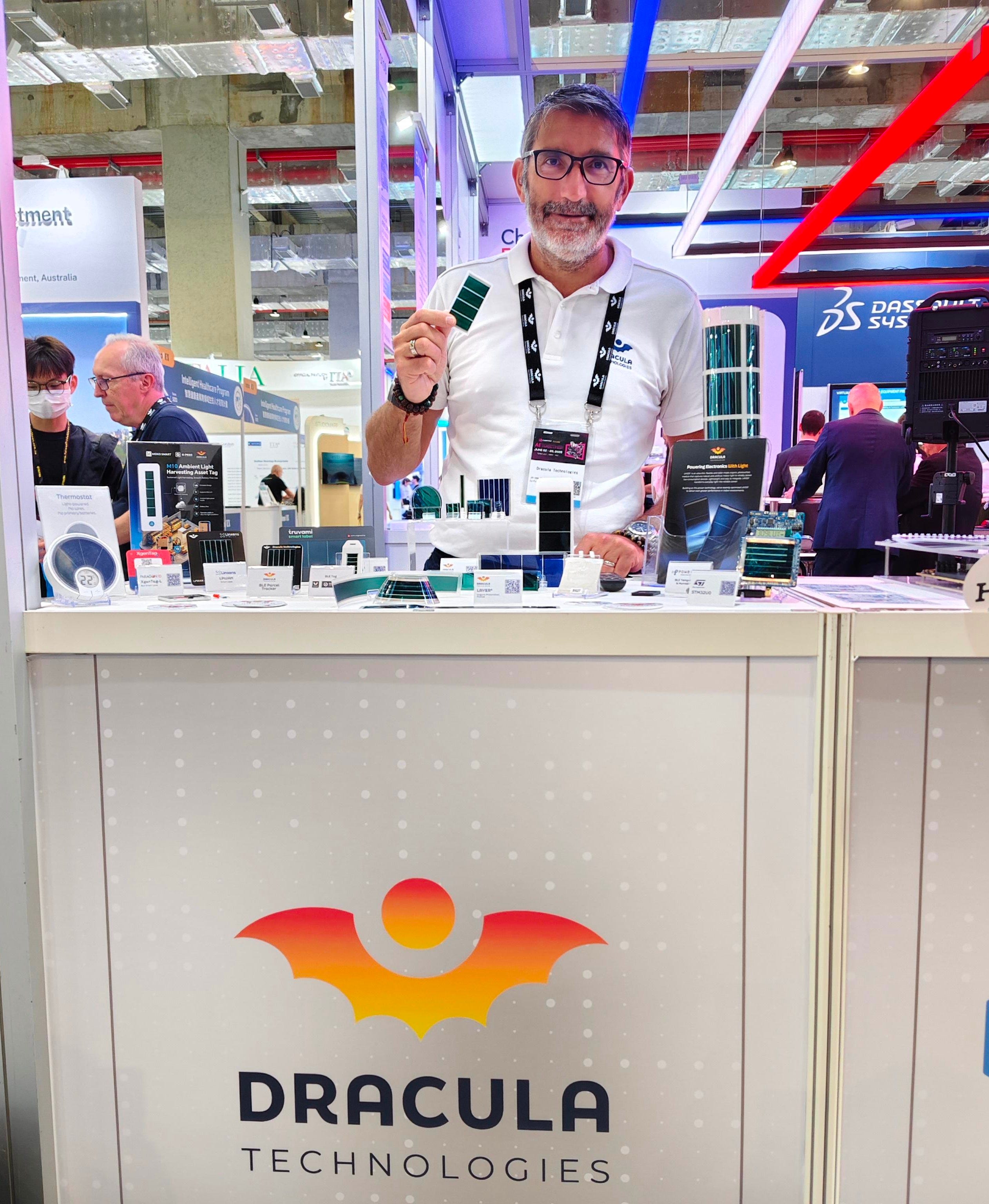
As global conversations at Computex heavily favor data-hungry artificial intelligence and massive server infrastructures, French deep-tech startup Dracula Technologies is quietly addressing the foundational layer enabling the digital revolution: the hardware that harvests data.
“Everybody speaks about data, everybody speaks about AI, but without reliable hardware, there’s no data, there’s no AI,” says Jerome Vernet, VP of Strategy and Co-Founder of Dracula Technologies, during an interview at the event. Celebrating its 14th year, the 50-person company is leveraging its proprietary light-harvesting technology to target one of the most pressing bottlenecks in the massive deployment of Internet of Things (IoT) devices—power consumption and battery maintenance.
Redefining Efficiency: “The Only Necessary Power”
Traditional IoT mass deployment is inherently restricted by power logistics. Swapping standard AA or AAA batteries across thousands of smart trackers, temperature sensors, or location beacons spread throughout a global enterprise is economically unfeasible and environmentally unsustainable.
Dracula’s solution replaces traditional chemical batteries entirely using Organic Photovoltaic (OPV) materials designed strictly for indoor applications. Rather than trying to harvest massive amounts of energy, Dracula’s core philosophy centers on keeping the power consumption footprint at an absolute minimum.
Using an advanced inkjet printing manufacturing process, Dracula prints flexible, PET-based organic solar cells. Because the material contains no rare earth materials or heavy metals, it is fully recyclable and holds an impressive lifespan of 8 to 10 years—significantly outlasting traditional battery solutions.
The cornerstone of their approach to minimal energy consumption is hyper-customization:
Tailored Electrical Profiles: Dracula designs cells to match the precise voltage and current requirements of a specific electronic component, preventing any wasted energy overhead.
Exact Geometric Proportions: Through inkjet printing, cells can be shaped into squares, rectangles, or circles.
“The beauty is that we can customize it to deliver the only necessary power to do the job,” Vernet explained. “The idea is to deliver the only necessary surface, not to oversize it. If we can make a tiny device, we make it.”
Sustaining Autonomy with Printed Storage
Because indoor artificial light fluctuates depending on human activity, an uninterrupted data stream requires a highly efficient energy storage system. Dracula tackles this challenge with two distinct hardware configurations depending on the device’s power threshold:
Printed Supercapacitors: For ultra-low-power sensors, Dracula has developed its own printed supercapacitors. This creates a completely self-contained system that stores just enough ambient energy during the day to seamlessly power the device through nights and weekends.
Hybrid Rechargeable Batteries: For slightly higher-draw applications (such as PC peripherals), Dracula integrates its OPV modules with small, internal rechargeable batteries that continuously top up under standard ambient light.
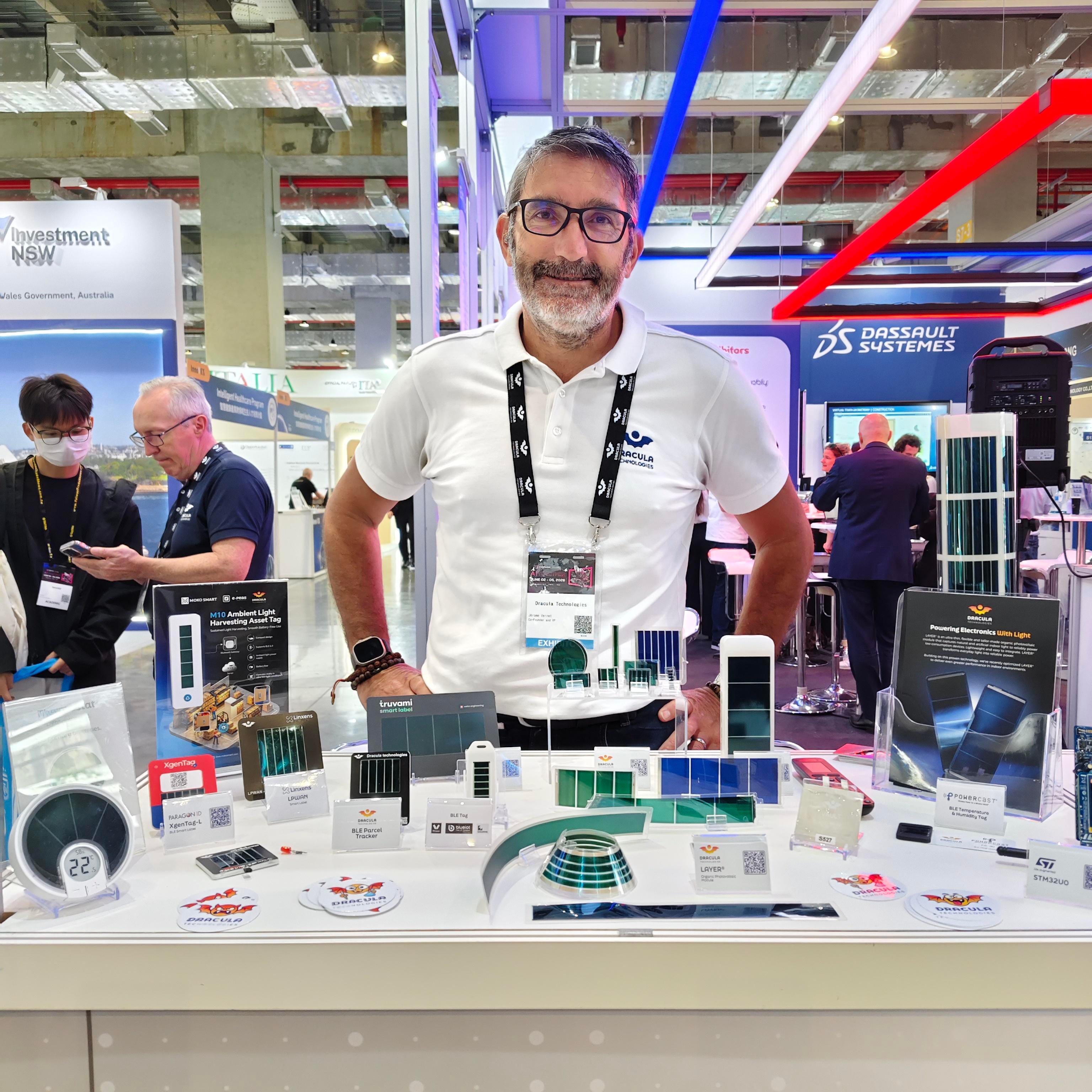
By aligning the photovoltaic size precisely with the storage capacity and environmental lighting conditions, the company ensures that sensors maintain continuous autonomy without over-consuming or drawing external grid power.
Scaling the IoT Niche and Eyes on Taiwan
While initially, clients requested large-format panels, Dracula has seen the market pivot sharply toward miniaturization. “You cannot imagine getting an A4-size panel on a sensor,” Vernet noted, clarifying that the sweet spot for the IoT market is going smaller and smaller. This niche has already gained traction among major hardware manufacturers; Dracula is currently working with major brands in PC peripherals to test their printed cells on everyday devices like wireless keyboards and mice.
Having finalized a €20 million Series A funding round recently, the company operates a mass production line out of its headquarters in France, already delivering tens of thousands of units for pre-series engineering projects.
However, Dracula’s multi-year presence at Computex underscores a broader geographic ambition. As the company looks to expand its global production capacity over the coming years, Vernet heavily signaled that the island’s world-class electronic and semiconductor ecosystems make it a premier candidate.
“Taipei for us is obvious,” said Vernet. “Looking for the opportunity to establish and deploy production in Asia, Taiwan could be a very good spot.”