
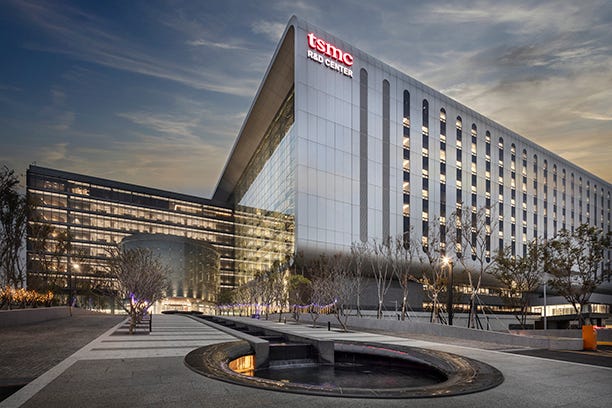
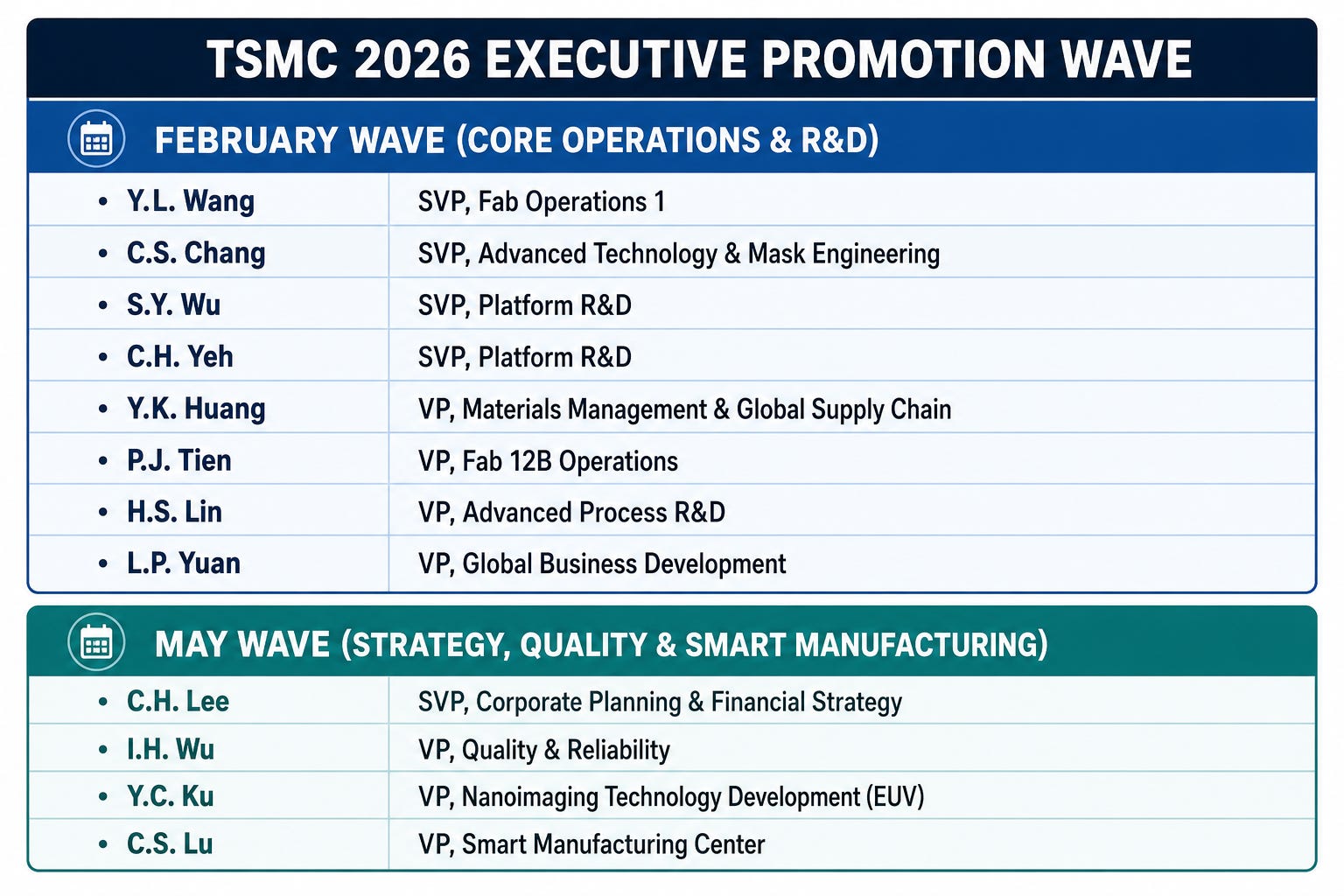
In February and May 2026, TSMC’s board approved two sweeping rounds of executive promotions, elevating twelve leaders into senior roles—five to Senior Vice President and seven to Vice President. It marks the largest leadership expansion in the foundry’s recent memory, expanding TSMC’s executive bench at the Vice President level and above to twenty-eight.
Spanning seven core functions—manufacturing, R&D, materials management, global sales, corporate planning, quality, and smart manufacturing—the moves signal that Chairman and CEO C.C. Wei, who took the helm in June 2024, is actively positioning his mid-generation succession bench.
Yet behind this technical firepower lies a critical governance question: Is TSMC building a leadership pipeline designed to manage a complex, multi-national corporation, or simply a deeper engineering bench?
I. The Mid-Generation Operators Step Up
The newly promoted executives represent TSMC’s “mid-generation vanguard”—most in their fifties, led by prominent figures like Y.L. Wang (55). Holding doctorates from top Taiwanese and international institutions, these leaders built their careers directly on R&D and fab operational front lines.
II. Strategic Signals: Flat Platforms and Global Replicability
This executive wave highlights two key strategic directions for TSMC’s future:
A Shift to Flat, Platform-Based Governance:
Since becoming Chairman in June 2024, C.C. Wei has prioritized institutionalizing generational handover. Promoting seasoned technical specialists in their early fifties provides a ten-to-twenty-year runway for operational stability while flattening decision-making across functions.
Standardizing Quality Across International Fabs:
Simultaneous fab construction in Kaohsiung, Tainan, Arizona, and Kumamoto places unmatched demands on supply chain resilience and yield replication. Promoting leaders in smart manufacturing (C.S. Lu) and quality control (I.H. Wu) indicates an aggressive push to export Taiwan’s AI-driven automated fab management to overseas sites, offsetting higher local labor costs and cultural operational gaps.
III. The Core Dilemma: Strong on Engineering, Thin on Management
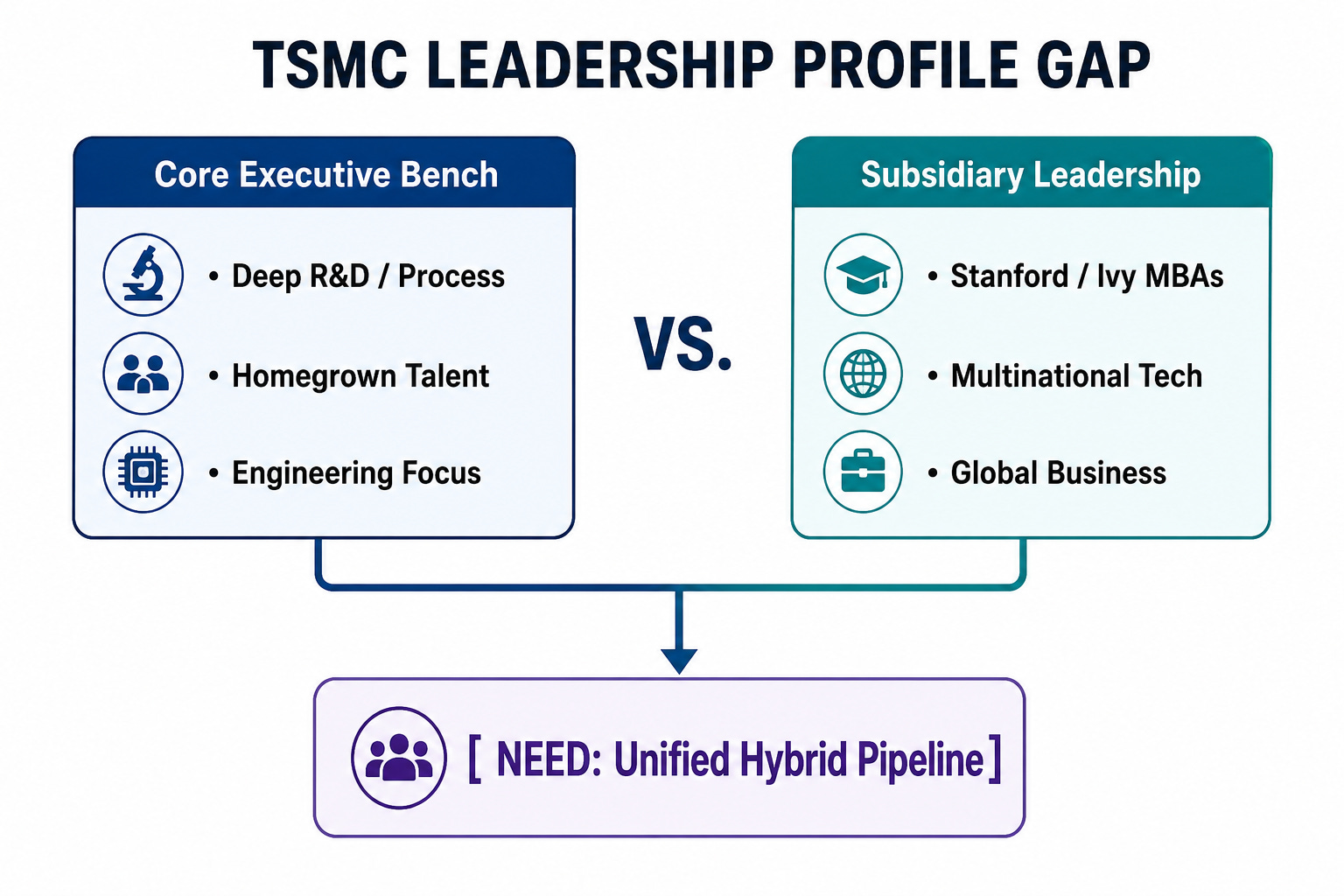
Rising through the technical ranks, these executives excel at silicon yield optimization, process breakthroughs, and cleanroom throughput. However, few possess formal management backgrounds or extensive experience leading cross-cultural teams.
The Hybrid Talent Gap: As TSMC scales globally, pure technical fluency is no longer sufficient. Running cross-border operations requires leaders who combine semiconductor expertise with talent governance, international regulatory navigation, and cross-cultural corporate management.
IV. Hybrid Talent Exists—But Outside the Core Decision Circle
Ironically, TSMC already possesses hybrid management talent, but these leaders are stationed primarily at the subsidiary level rather than within the central succession pipeline:
Sajiv Dalal (President & CEO, TSMC North America): Stanford MS in Chemical Engineering, Santa Clara MBA, with over four decades of semiconductor experience spanning engineering, sales, and executive management at National Semiconductor and Epson.
Christopher Thomas (President, TSMC Europe): Stanford MA, UPenn Economics background, former McKinsey Partner, Intel China GM, and startup founder before joining TSMC in 2026.
Makoto Onodera (President, TSMC Japan): Built decades of local market leadership within multinational structures after joining from Applied Materials Japan in 1997.
Frank Lo (Head of TSMC China): Decades of experience navigating local business operations and governance from within TSMC’s subsidiary framework.
These executives bring a blend of consulting, global corporate leadership, and local management experience. Yet today, this international talent remains parked in regional business units rather than integrated into HQ decision-making tracks in Hsinchu.
V. Why Globalization Demands International Governance
Every executive in TSMC’s 2026 promotion wave is Taiwanese and internally promoted. While this preserves company culture and process secrets, it contrasts sharply with global peers like Intel or Samsung, which regularly integrate senior executives with diverse international backgrounds into core governance roles.
As fabs in Arizona and Kumamoto ramp up volume production, TSMC is transitioning from a Taiwan-centered exporter into a multinational entity. Without bringing international executives who understand local labor laws, cultural nuances, and cross-border team management into the core decision-making circle, friction costs could quietly erode operational efficiency over time.
VI. The Modern Tech CEO Playbook: Vision, Tech, and Geopolitics
Global tech leaders at companies like Nvidia, Microsoft, and Google demonstrate three critical competencies required for modern tech governance:
Global Market Vision: Navigating disparate talent markets, regulatory environments, and customer demands across continents simultaneously.
Frontier Tech Instincts: Staying personally anchored in technological inflections—such as AI acceleration and advanced packaging—rather than relying solely on briefings.
Geopolitical Acumen: Managing trade friction, export controls, and supply chain realignment with diplomatic dexterity.
As the focal point of the global technology supply chain, TSMC operates under intense geopolitical scrutiny. Treating leadership succession strictly as a technical handoff risks underpreparing the next generation for international diplomacy and strategic global trade.
Conclusion: Upgrading from Technical Strength to Global Governance
TSMC’s mid-generation promotion wave secures its immediate operational and technological foundation. However, navigating the next decade of multi-site global expansion will require more than engineering excellence.
To ensure long-term resilience, TSMC must evolve its succession framework—bridging its core engineering bench with international management expertise to upgrade not just its process technology, but its global corporate governance.
Previous articles:


