
Cortex Advisory Research Note: Grading 7 Semiconductor Predictions 6 Months Later
The boldest bearish call of late 2025 just got proven wrong. But the real signal isn't who missed — it's that the market missed in one direction.
Spend enough time in industry research, and you pick up an almost compulsive habit: write down what people sounded most certain about, date it, and put it away. Months later, pull it back out and grade it. It isn’t a flattering exercise — it records other people’s misses, and your own — but it’s one of the few honest ways to test an industry’s collective judgment. Predictions are everywhere. What’s scarce is anyone willing to go back and check.
So we took the specific, sourced predictions the semiconductor world made in the second half of 2025 — from bank research desks, third-party research houses, supply-chain analysts with a track record — and graded them one by one, six months on. The bar was strict: only calls with a number and a date counted. The hedged “cautiously optimistic” filler was thrown out.
The final tally: of seven traceable calls, five hit, one missed, one is still open.
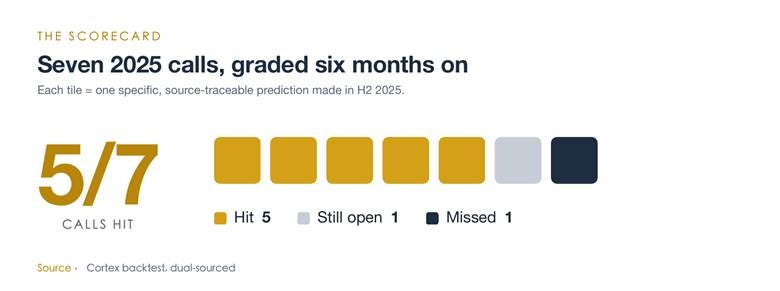
Seven traceable calls, graded: five hit, one missed, one open.
The five that hit weren’t timid. TrendForce flagged in late 2025 that high-margin server DDR5 would crowd out capacity and push resources toward HBM, tipping memory into a “structural super-cycle” rather than a passing squeeze — it happened. SK Group chairman Chey Tae-won and TrendForce both forecast that the HBM4 generation would end SK hynix’s exclusivity, with Samsung and Micron catching up — that happened too, when NVIDIA certified three HBM4 suppliers in June. Someone called TSMC’s 2026 capex toward $50B on 2nm and advanced-packaging expansion; TSMC then guided to $52–56B, higher than the “bold” number. In hindsight, the aggressive calls were the ones that turned out too conservative.
5 / 7 Of seven traceable, specific calls, five hit and one is still open — and the only outright miss was the one most people believed
The miss is the one worth sitting with.
In July 2025, Goldman cut its 2026 HBM market estimate by 13%, from roughly $51B, on impeccable-sounding logic: bit supply was about to flood in, SK hynix would lose pricing power, and so HBM average prices would post a “double-digit decline.” The bearish case was widely repeated because it matched everyone’s muscle memory of this industry — supply rushes in, prices crater. It’s the script that the memory cycle has run dozens of times over thirty years.
The script didn’t repeat. In the first quarter of 2026, DRAM industry revenue alone jumped 81% quarter-on-quarter to $97B; SK hynix posted a 72% operating margin, Micron 69%. HBM didn’t just hold — it became the scarcest, highest-pricing-power node in the industry, scarce enough that suppliers signed fixed-price, three-to-five-year contracts and locked up 2026 capacity outright. A component that the market expected to be cheap became the one that sellers priced as they wished.
Lay all seven side by side, and something more interesting than a hit rate appears: the industry’s errors pointed the same way.
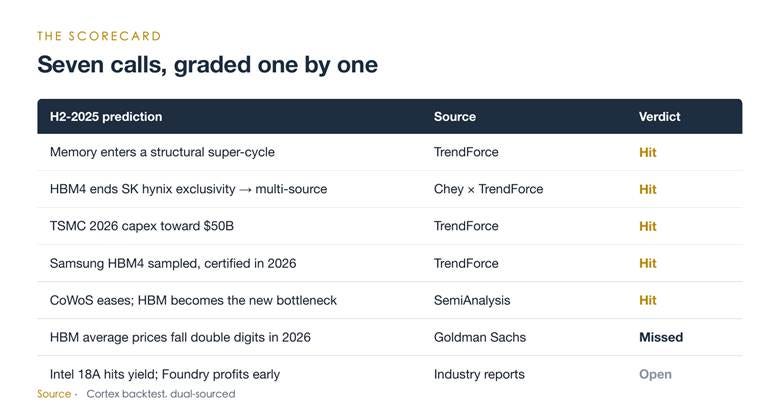
The bearish call was fully refuted; four of five bullish calls landed. Which means the consensus of late 2025 wasn’t, on balance, too optimistic — it was too conservative. It systematically underestimated one thing: once AI lifted the entire memory demand curve, how long that pull would last.
In a textbook cyclical industry, that’s counterintuitive. For three or four decades, the classic analyst error in memory was being too bullish at the peak, then getting punished by the inventory correction that followed. The whole industry’s reflex is to guard against froth at the top. This time the error ran the other way: in a cycle visibly rewriting records, the mainstream view still clung to the old frame — supply up, prices down — and underestimated, again and again. The model wasn’t off by a few points; people were reading a new road off an old map. The map wasn’t broken. It had simply never covered this road.
That’s the real takeaway from the scorecard. When the market’s collective error has a direction, it isn’t random noise — it’s a systematic bias you can recognize, and sometimes lean against. Next time you read that “memory is about to cool,” it’s worth pausing on one question: is this built on demand, structurally softening, or is it one more reflexive reach for last cycle’s script? The two lead to opposite conclusions — and over the past six months, it was the second that cost people an entire turn in the cycle.
Adapted from Cortex Advisory’s Global Semiconductor Industry — H1 2026 Deep Dive. Cortex Advisory is an independent strategy research firm focused on semiconductors and AI infrastructure supply chains.
More research & deep dives → cortex-advisory.com
SOURCES
WSTS, Global Semiconductor Market Forecast 2026 — https://www.wsts.org/76/103/Global-Semiconductor-Market-Surges-Beyond-15T-2026
TrendForce, Q1 2026 global DRAM industry revenue — https://www.trendforce.com/presscenter/news/20260601-13070.html
SK hynix, Q1 2026 business results — https://news.skhynix.com/q1-2026-business-results/
Micron FQ2-2026 (HBM sold out, long-term contracts) — https://futurumgroup.com/insights/micron-q2-fy-2026-earnings-driven-by-ai-led-memory-demand/
TSMC 2026 capex guidance ($52–56B) — https://www.datacenterdynamics.com/en/news/tsmc-announces-2026-capex-spend-of-56bn-after-posting-eighth-consecutive-quarter-of-growth/
NVIDIA certifies three HBM4 suppliers — https://finance.yahoo.com/sectors/technology/articles/nvidia-certifies-samsung-sk-hynix-133001560.html
Goldman Sachs 2026 HBM market downgrade (via Economic Daily, 2025-07)
Chey Tae-won × TrendForce: HBM4 diversification call (2025-07)
About Cortex Advisory:
 | A guest post by
|