
Cortex Advisory Research Note #3: The real bottleneck in AI chips isn't capacity
Everyone assumes AI chips are scarce because they're hard to build. The most underrated shift of H1 2026 is that the bottleneck quietly moved — from capacity to who gets a certification seat.
Ask why AI chips are scarce, and most people’s first instinct is capacity: fabs can’t keep up, packaging is jammed. That frame mostly held in 2024 and 2025, when the tightest link in the chain was TSMC’s CoWoS advanced packaging — the step that stacks a compute die and a bank of high-bandwidth memory (HBM) onto one substrate, which nearly every high-end AI accelerator has to pass through.
But through the first half of 2026, that bottleneck is loosening. And the way it’s loosening is more telling than the shortage itself.
20% → 10% TSMC’s CoWoS supply gap is projected to narrow from about 20% early in 2026 to about 10% by year-end — the old packaging bottleneck is being caught by capacity
By TrendForce’s tracking, TSMC’s CoWoS monthly capacity is expanding toward 120,000–140,000 wafers by the end of 2026, with the supply gap narrowing from roughly 20% early in the year to about 10% by year-end. TSMC’s 2nm node also entered volume production in Q4 2025 and ramps through 2026. In other words, the “can’t build it” bottleneck that dogged the industry for two years is steadily being caught by capacity.
By rights, easing packaging should ease AI-chip lead times. It hasn’t — because the binding constraint relocated: from packaging to HBM allocation.
The HBM story turned structurally in the first half of 2026. It used to be SK Hynix supplying NVIDIA almost exclusively. In June, NVIDIA certified three HBM4 suppliers at once. On the surface, that reads as diversification and relief. But “certified three” isn’t “split evenly” — by early supply-chain estimates, SK hynix still holds about 60–70% of Rubin-generation allocation, Samsung about 20–30%. Whether you make NVIDIA’s certified list, and how large a share you get on it, has become more decisive than whether you can produce more.
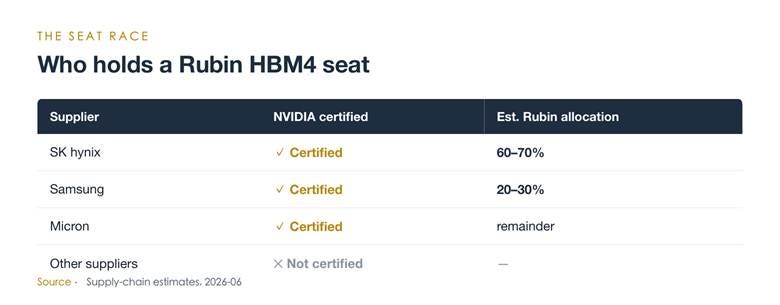
Three certified, but allocation is highly skewed — that’s the seat race.
That’s the most underrated shift of the half: the bottleneck moved from capacity to seats.
For a memory maker, the battlefield is no longer simply expanding output and pushing yield — it’s getting onto NVIDIA’s certified list and then holding, or growing, a share on it. The map moves with that logic: in HBM bit share, SK Hynix is projected to slip from about 59% toward 50%, while Samsung pushes from about 20% toward 28%. Those swings aren’t won by selling more standard product; they’re decided by how certification seats get reallocated. A vendor’s share rises not because it built new fabs, but because of where it sits on NVIDIA’s list.
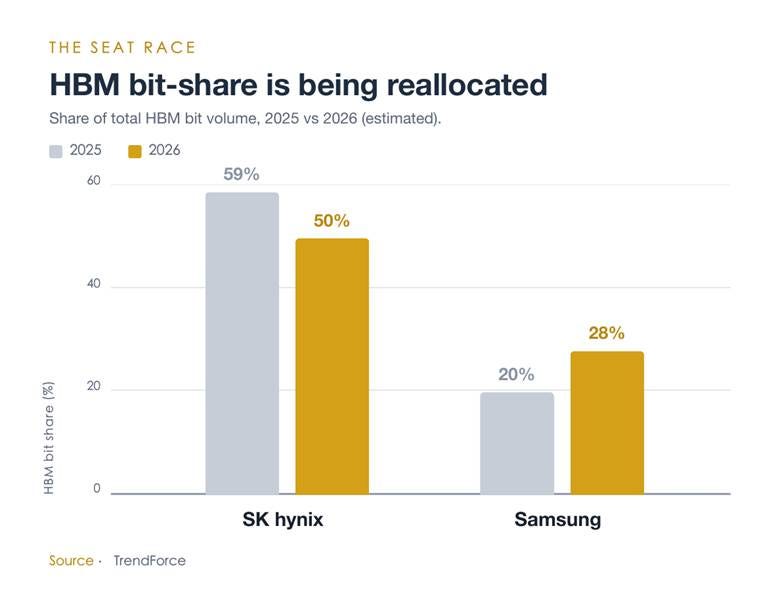
HBM bit-share reallocates: SK hynix down, Samsung up.
Why seats, not capacity? Because an AI accelerator is a tightly spec-bound system. HBM has to clear certification — pinout, timing, integration validation — before it gets into the chain; it’s not a drop-in standard part but a custom component bound to a specific accelerator generation. You can add capacity with capex, but the number, allocation, and timing of certification seats sit with NVIDIA. Who gets listed and who gets shut out largely sets where each supplier stands across the next two AI buying cycles.
Which is why, once the bottleneck shifts from capacity to seats, the nature of the contest changes. The capacity race is a contest of capital and engineering — with money, technology, and time, you catch up; it’s brutal, but at least fair and predictable. The seat race is different: it turns on whether your yield is stable enough, your spec fit close enough, your timing early enough, and — above all — whether the buyer will bet a generation of orders on you. None of that is reliably for sale. Miss one certification generation and catching up usually means waiting for the next product window to reopen.
So what memory suppliers should really watch in the second half of 2026 may not be how much capacity they can add, but whether their place on NVIDIA’s next certified list is moving up or down. The capacity race is visible and countable; the seat race is far quieter — and far more likely to decide who actually wins this round.
Adapted from Cortex Advisory’s Global Semiconductor Industry — H1 2026 Deep Dive. Cortex Advisory is an independent strategy research firm focused on semiconductors and AI infrastructure supply chains.
More research & deep dives → cortex-advisory.com
SOURCES
TrendForce, TSMC CoWoS gap narrowing ~20% → ~10% by end-2026 — https://www.trendforce.com/news/2026/06/15/news-tsmc-cowos-supply-demand-gap-reportedly-seen-narrowing-from-20-to-10-by-end-2026-as-capacity-expands/
Tom’s Hardware, TSMC 2nm enters volume production in Q4 2025 — https://www.tomshardware.com/tech-industry/semiconductors/tsmc-begins-quietly-volume-production-of-2nm-class-chips-first-gaa-transistor-for-tsmc-claims-up-to-15-percent-improvement-at-iso-power
NVIDIA certifies three Rubin HBM4 suppliers; supply-chain allocation estimates — https://finance.yahoo.com/sectors/technology/articles/nvidia-certifies-samsung-sk-hynix-133001560.html
TrendForce, HBM bit share 2025 vs 2026 — https://www.trendforce.com/news/2026/03/09/news-samsung-sk%E2%80%AFhynix-reportedly-tapped-as-nvidia-rubin-hbm4-suppliers-shipments-could-start-in-march/
 | A guest post by
|