

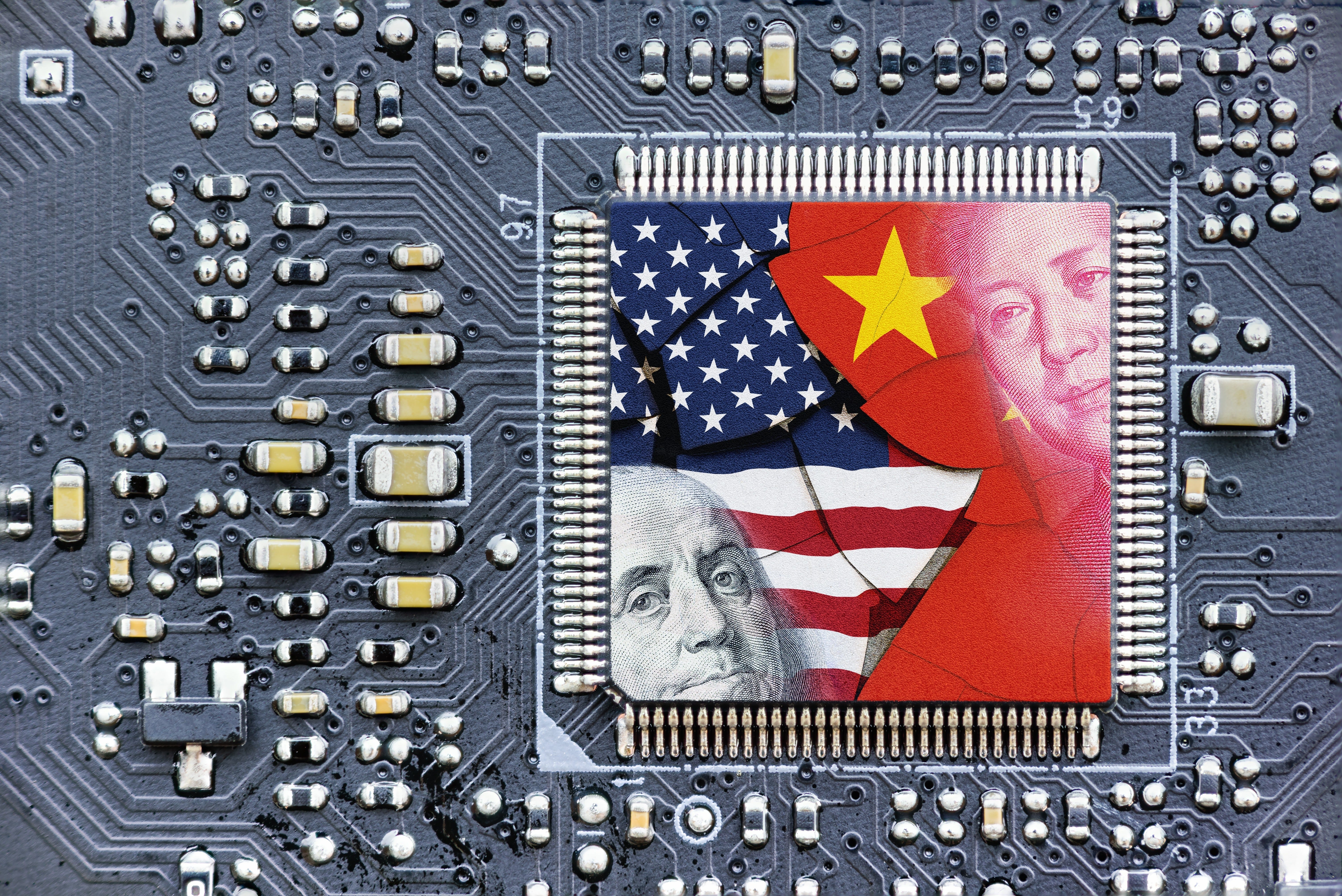
The U.S. export controls aimed at restricting China’s access to advanced chips and manufacturing equipment were significantly strengthened in October 2022, and recent reporting and think tank analysis indicate it is critical to assess their effectiveness and unintended consequences.
Summary of this episode:
The initial policy goals were to impair China’s AI and supercomputing capabilities, stop their ability to design and make high-end chips, and prevent the development of their own advanced manufacturing equipment. However, key evidence suggests these controls have backfired, leading to a self-defeating outcome that harms U.S. competitiveness while accelerating China’s technological independence.
The initial U.S. policy significantly underestimated the scale and sophistication of the circumvention that would follow. Investigative work by tech journalist Liu Qian’er uncovered a massive, global “shadow chip economy” designed specifically to bypass Washington’s export controls.
The Next-Gen Threat
CSIS warns that the threat is no longer just Huawei but the smaller, faster innovators that the sanctions have “lit a fire under” across the whole national ecosystem.
DeepSeek’s Efficiency: The startup DeepSeek unveiled an open-source AI model, R1, that CSIS says roughly matches the capabilities of models from Google, OpenAI, and Meta. Crucially, they achieved this with fewer resources than their Western rivals, suggesting China may be optimizing AI development faster and smarter than the West anticipated.
Leapfrog Technologies: Chinese research is actively trying to “redefine computing to get around Western tech”:
2D Transistor: Peking University unveiled a 2D transistor that could be 40% faster than TSMC’s best chips while using less power.
Carbon Nanotube Chip: Scientists built a chip using novel ternary logic for potentially massive increases in information density and energy efficiency.
RISC-V: Alibaba’s new CPU uses the open-source RISC-V architecture, which is fundamentally immune to U.S. export controls, providing a path to self-sufficiency.
The Path Forward: A Global, Pro-Innovation Strategy
Both CSIS and ITIF agree that the current policy is failing and must be reset. The proposed pivot is from a strategy of restricting a rival to one focused on promoting American and allied leadership.
Key Recommendations for a Positive U.S. Reset:
Coordinated Controls: Export controls must be applied jointly with allies or not at all. Unilateral controls simply give away market share and R&D capital to friendly competitors.
R&D Impact Assessment: Future controls must seriously consider the negative impact on U.S. firms’ ability to fund their own R&D.
Sustained Public Investment: The U.S. needs a comprehensive industrial and research policy with massive, sustained public investment in semiconductor research, engineering, and science. The focus must be on American invention, ensuring Western firms stay on the cutting edge.
The long-term strategy acknowledges that if the U.S. remains focused only on restricting today’s chips, China might just leapfrog with tomorrow’s technology, like 2D transistors or carbon nanotube chips.
Reference:
https://www.nccu.edu.tw/p/406-1000-21063,r17.php?Lang=zh-tw
https://itif.org/publications/2025/10/27/backfire-export-controls-helped-huawei-and-hurt-us-firms/
https://www.csis.org/analysis/limits-chip-export-controls-meeting-china-challenge


