
Canadian Medtech Innovator Seeks Strategic Partnerships—and a New Kind of ‘Karma’ in Taiwan
They turn machining precision into life-changing medical innovation. You're invited to build the next chapter.
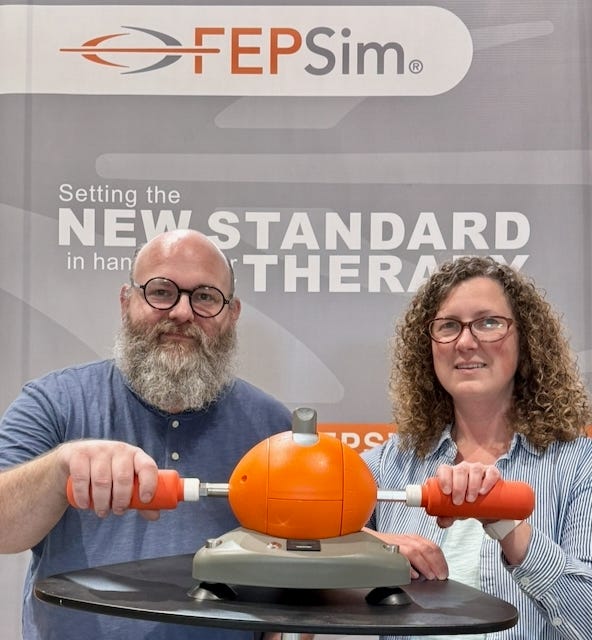
There’s a certain irony in the name. Karma Medical Products. In Taiwan, it means world-class mobility. In Canada, it’s a machinist who reinvented rehab tech.
Meet Darryl Short: The Edmonton entrepreneur who built the FEPSim®—a “missing link” device that’s changing stroke and injury recovery.
Co-Founder of Karma Machining and Manufacturing and Karma Medical Products Ltd., Darryl Short, is in Taiwan with a clear mission: to find smart, values-aligned partners who want to help them build the next generation of IoT-enabled future of upper-extremity rehab—and to change the way the world thinks about upper-extremity recovery.
Built Different: From Machining Steel to Rebuilding Lives
Karma’s story doesn’t start in a boardroom. It starts in a machine shop—one built by people who make products, not PowerPoints.
Short is a certified machinist and mechanical technologist who spent his career turning ideas into physical products. His wife and co-founder, Melissa, is an occupational therapy assistant who knows what rehab success looks like from the front lines.
Together, they did something unusual: they turned their shop’s precision manufacturing know-how into med-tech innovation.
The result was FEPSim®—the Flexion-Extension-Pronation-Supination Simulator—a deceptively simple rehabilitation tool that’s now helping patients regain movement after stroke, spinal cord injury, or orthopedic trauma. “We’re exploring aging-in-place use cases, where older adults or individuals with spinal cord injuries may not be able to access traditional gym settings,” said Short. “Our goal is to bring the product out of the gym and into group environments to help people practice and maintain everyday functional movements.”
Filling the Gap Everyone Ignored
Walk into any clinic and you’ll find the same tools therapists have used for decades: elastic bands, wooden dowels, or, at the other end of the option spectrum, maybe a major piece of equipment that costs $85,000.
FEPSim fills a gap in the middle with a portable, affordable, and outcomes-driven system. It’s built for real-world function: grip, twist, lift, and turn.
One-third of the planet will experience upper-limb issues at some point. That’s a billion people. Karma’s goal is to make accessible recovery tools that are effective for them.
Clinical trials at the Glenrose Rehabilitation Hospital and Barrow Neurological Institute praise FEPSim as “excellent” for usability and outcomes. Therapists call it “the missing link.”
Taiwan: The Next Chapter
Karma’s next evolution is the FEPSim Digital system—a smart, IoT-enabled version that connects biomechanics with data analytics. It will measure range, resistance, fatigue, and progress while creating a new dataset for early detection of conditions like ALS and Parkinson’s.
To get there, Karma is looking to Taiwan’s electronics and manufacturing ecosystem—and to partners who share their obsession with precision and purpose.
The company’s objectives at the 2025 Healthcare+ Expo in Taipei are bluntly simple:
Build long-term manufacturing and R&D partnerships for FEPSim Digital.
Collaborate on smart attachments and pressure-mapping sensors.
Explore co-development or licensing for the broader Asia-Pacific market.
Protect IP while building trust—because ethics matter.
Short puts it plainly: “We’re self-funded, and relentless. We want partners who see what’s coming and want to help shape it.”
A New Kind of Karma
Karma’s DNA is grit, honesty, and curiosity. The team’s mantra Help People Faster — drives every product decision.
For Taiwan’s med-tech and manufacturing community, this visit isn’t just another trade mission. It’s an invitation to build something that matters—something that helps millions of people use their hands and upper extremities again.
Because, as Short likes to say, “We make really good stuff. And when that good stuff helps people, it has a way of coming back around. That’s good Karma.”
Read the Mandarin version:
