Beyond the Deck #41: Management Is a Skill, Leadership Is an Inside Job
What first-time managers in tech get wrong — and what emotional intelligence fixes.
You were good at your job. Really good. So good that someone decided to reward you by giving you a completely different one.
Welcome to management.
Nobody told you that the promotion would feel like starting over. That the instincts that made you exceptional as an individual contributor — the focus, the precision, the ability to just put your head down and deliver would suddenly become liabilities. That your team doesn’t need you to do the work. They need you to make it possible for them to do it. This is the gap no job description prepares you for. And for most first-time managers, the fall into it is quiet, slow, and confusing.
Managing and Leading Are Not the Same Thing
Here’s a distinction worth sitting with:
Management is the domain of systems. Timelines, outputs, accountability, process. A good manager keeps the machine running. They know where the work is, who owns it, and whether it’s on track. These are learnable skills. With the right frameworks and enough reps, almost anyone can become a competent manager.
Leadership is the domain of people. Trust, motivation, culture, growth. A good leader makes people want to follow them — not because of their title, but because of how they make people feel. Heard. Trusted. Capable of more than they thought.
You can be a rigorous manager and a poor leader. Organised, reliable, on top of every deadline — and still have a team that’s quietly disengaged, counting down to their next opportunity to leave.
You can also be an inspiring leader and a disorganised manager. People love working for you, but nothing ever ships on time.
The best managers are both. But here’s what most first-time managers don’t realise: you can study your way to competent management. Leadership is something else entirely. It has to come from the inside.
The Skills That Built Your Career Won’t Build Your Team
In tech, especially, the path to management is often a straight line from individual excellence. Best engineer. Best marketer. Best analyst. The logic makes sense on paper — if you understand the work deeply, you can guide others in doing it.
But there’s a problem. The skills that made you exceptional, such as deep focus, high standards, and the ability to solve problems independently, can actively work against you as a manager.
The deep focus becomes micromanagement. The high standards become a bottleneck when you can’t let go. The ability to solve things independently means you jump in before your team has the chance to figure it out for themselves.
The transition from doing to enabling is not automatic. And most organisations don’t teach it.
This Is Where Emotional Intelligence Enters
Emotional intelligence is the ability to recognise, understand, and manage emotions in yourself and in others — is not a soft skill. It is the hard work of leadership.
It is the ability to read into the team member perceived as being difficult was actually overwhelmed and did not know how to ask for help.
It is what stops you from sending that reactive email immediately when a project goes sideways or when you receive an unpleasant email.
It is what lets you give honest feedback without the other person feeling attacked.
For first-time managers, emotional intelligence shows up in four critical ways:
Self-Awareness
Do you know what triggers you? Do you know how you show up under pressure and what that does to the people around you?
A manager who lacks self-awareness doesn’t just struggle personally. They create environments where teams walk on eggshells.
Self-Regulation
Your bad Tuesday doesn’t have to become your team’s bad Tuesday. This sounds simple and not at the same time.
The ability to process your own stress before it becomes someone else’s problem is one of the most underrated leadership skills there is.
Empathy
This isn’t about being nice. It’s about being accurate. Empathy lets you read what a person actually needs in a given moment. Sometimes that’s direction, sometimes it’s space, sometimes it’s just to feel like someone noticed they were struggling. Getting this wrong consistently is how managers lose their best people.
Situational Intelligence
Knowing when the moment calls for a process and when it calls for a person. Some problems are structural. Some are emotional. Confusing the two is where well-meaning managers make their most costly mistakes.
Emotional intelligence can absolutely be taught. The idea that emotional intelligence is something we are born with is a myth—IQ is innate and something we’re born with. But emotional intelligence is a set of skills and competencies that can be learnt.
So, Where Do You Actually Start?
Knowing that emotional intelligence matters is one thing. Knowing where you stand is another, and that’s where tools like the EQ-i 2.0 become genuinely useful. The EQ-i 2.0 is one of the most widely used and recognised EI assessment tools in the world, measuring emotional intelligence among 15 subscales grouped under 5 main composite scales, where your self-perception affects your self-expression, which in turn feeds into how you manage interpersonal communication and relationships, as well as how you manage your stress. These 15 subscales determine how you show up at work, at home, or at play.
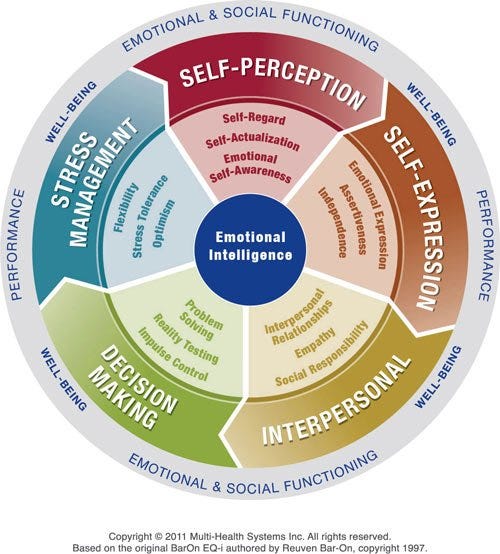
For first-time managers, getting specificity about their emotional intelligence is extremely valuable because you can only change what you can measure. Development becomes targeted, not guesswork. And for managers navigating a steep learning curve, that clarity can make all the difference.
There is an insurmountable pile of research that backs up emotional intelligence as a job performance indicator. Yale School of Medicine researchers have concluded that workplace success starts with emotional intelligence and have found that emotionally intelligent employees are happier with their jobs because they perform better, achieve more merit-based pay increases, gain recognition for their work, and reach higher company ranks.
Emotionally intelligent leaders create a positive work culture and climate that lets these employers thrive and prosper. When workers are satisfied and engaged, turnover is less costly, and when they approach their jobs with purpose, they are much better at finding creative ways to solve problems.
Organizations with emotionally intelligent leaders and workers also statistically bring in more money for the company. Boyatzis, R. E. (1999) found that experienced partners at a multinational consulting firm were assessed on EI competencies and three others. Those who scored above the media on 9 or more of the 20 competencies delivered $1.2 million more profit from their accounts vis-à-vis other partners, which accounts for a 139% incremental gain.
The Bridge Between Good Manager and Great Leader
Management can be learned in a course, a book, or a framework. It is a skill, and like most skills, it improves with practice and feedback.
Leadership is different. It is built in the quiet moments, like the conversation you had honestly instead of conveniently, the time you regulated your reaction when you wanted to react, the feedback you gave that was hard to say and harder to hear.
Emotional intelligence is not the only ingredient in great leadership. But it is the bridge between a manager who runs a team and a leader who develops one.
First-time managers who invest in their emotional intelligence early don’t just become better leaders faster. They build teams that perform better, stay longer, and — perhaps most importantly — do their best work not because they have to, but because they want to.
In the age of AI, being a human-first leader and manager becomes a superpower, and emotional intelligence is the key to unlocking this superpower.
About the author: Angela Lau is the CEO and Founder of the Corporate Poets Dept.