Beyond the Deck #32: Simplify Is to Smartify: Clarity is the Ultimate Superpower
“Simple Is the New Superpower” — because the more you say, the less you communicate, and the less influence you have.

One early Saturday morning, I got a text from a friend who had just finished judging a startup pitching competition in Los Angeles. I was barely awake, but I was eager to hear her verdict.
“Too long-winded.”
“They kept going around in circles.”
“At one point, it was painful to watch.”
As I was about to commiserate, she surprisingly added, “But there was one that did really well. Her English wasn’t the best — but she had a great narrative and a good hook.”
Her hook? “Did you know bananas are disappearing?”
Six words. Zero jargon. That founder beat out polished presenters with MBA vocabularies and meticulously rehearsed decks. Not because her idea was superior—but because she did what most founders are too proud, or too afraid, to do: she made it digestible. She respected the audience’s “cognitive load.”
The Complexity Trap
Somewhere along the way, we conflated complexity with competence. In the tech world, we dress ideas in layers of jargon as if sophistication were a proxy for intelligence. It isn’t.
Communication expert and the author of “Talk Like TED,” Carmine Gallo, calls simple the “new superpower.”
“Big picture, storytelling, and simplicity. If you can master those three ingredients, you’ll be head and shoulders above the vast majority of business professionals,” said Gallo.
The Smartify Shift:
The Amateur: Explains how the engine works to prove they are smart.
The Master: Explains where the car can take you, so the audience feels smart.
The Science of “Cognitive Fluency”

This isn’t just soft advice; it’s biological. In his research for Writing for Impact, Bill Birchard (2023) synthesized decades of cognitive science to show that the brain rewards simplicity.
When we process information easily, we experience Cognitive Fluency. This isn’t just about speed; it’s about trust. Research on the “Illusory Truth Effect” (Hasher, Goldstein, & Toppino) suggests that the easier a statement is to process, the more likely the brain is to judge it as true.
When you use jargon, you aren’t sounding “expert”—you are literally triggering a “danger” signal in your listener’s brain that says: This is hard work, and I’m not sure I trust it.
Simply put, the more complex jargon you use, the more you are adding to the listener’s “cognitive load.” Remember, the female founder who wowed the judges? She impressed them from the get-go because her hook was so easy for the brain to process.
Simple vs. Simplified: A Translation Guide
The biggest fear for tech leaders is “dumbing it down.” But there is a massive difference between oversimplifying (losing the point) and distilling (finding the point).
The “Complexity” Trap
The “Smartified” Version
“We leverage a synergistic decentralized protocol to optimize data latency.”
“We make the internet feel 10x faster.”
“Our proprietary algorithm utilizes neural-linguistic modeling to maximize UX.”
“Our app talks to you like a human.”
“We are seeking a Series A to scale our go-to-market infrastructure.”
“We need $5M to get this into every home in Asia.”
The “Smartify” Framework: The Four C’s
Matt Abhram, a professor at Stanford Graduate School of Business, once said “just tell me the time, don’t build me the clock.” To move from a deck that “builds the clock” to one that wins the room, apply these four filters:
Clear: Eliminate ambiguity. If a 10-year-old can’t explain your business to their friends after hearing your pitch, you haven’t mastered the material yet. This is the Feynman Technique: Mastery is the ability to explain the complex simply.
Concise: Every word is a “tax” on your audience. Use the 10-Word Summary test: If you can’t describe your value proposition in ten words or fewer, you don’t have a value proposition; you have a collection of features.
Compelling: Simplicity needs a hook. The “banana” hook worked because it disrupted patterns and forced the brain to stop scanning and start listening.
Confident: Confidence is the courage to use small words. When you strip away the filler, what remains is your conviction.
Investors or your company leaders aren’t short on time because they’re rude; they’re short on time because they’ve sat through too many “clocks” and never found out the “time.”
When your message is direct, your confidence becomes magnetic. When your idea is digestible, your credibility is immediate. Simplifying is not about talking down to your audience—it is about being disciplined enough to do the hard work of clarity for them.
That is what it means to Smartify.
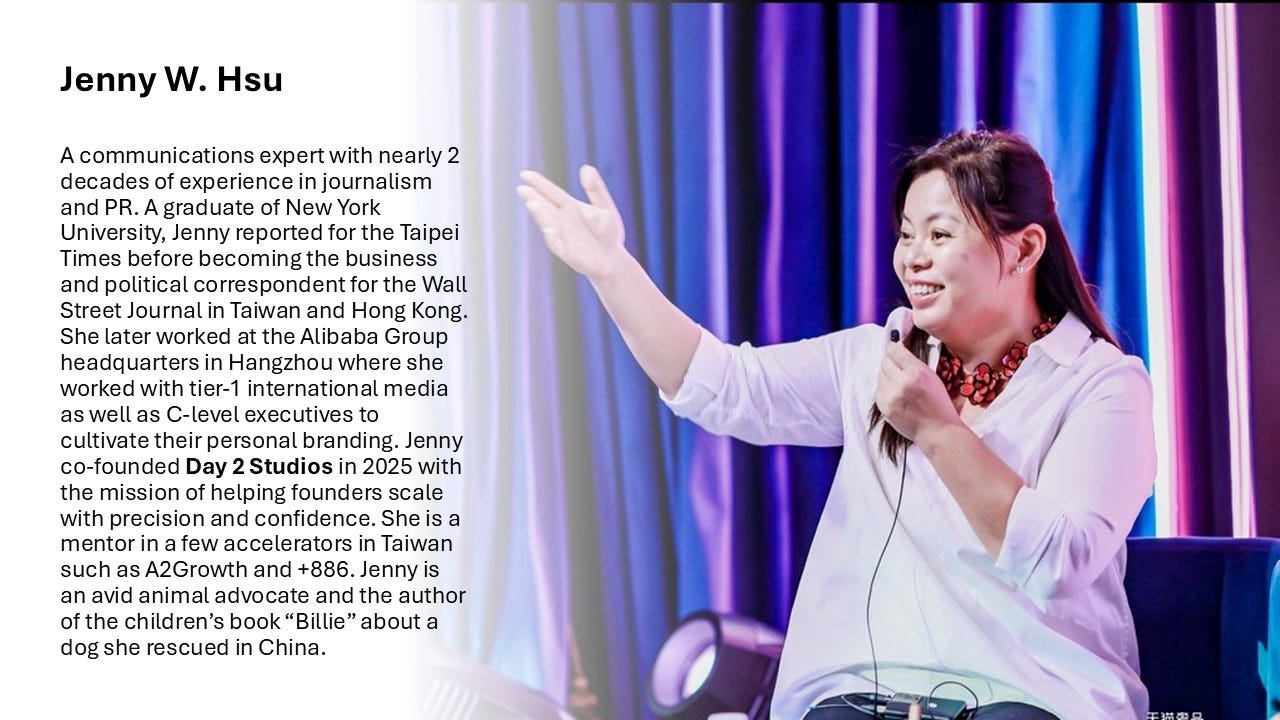
About the author: Jenny W. Hsu is Co-founder and Chief Creator of Day 2 Studios.