
Anthropic Explores Custom 2nm AI Chip with Samsung, Intensifying the Race Beyond Nvidia
Anthropic's exploration of a Samsung-made AI chip signals that the future of AI competition extends far beyond model development
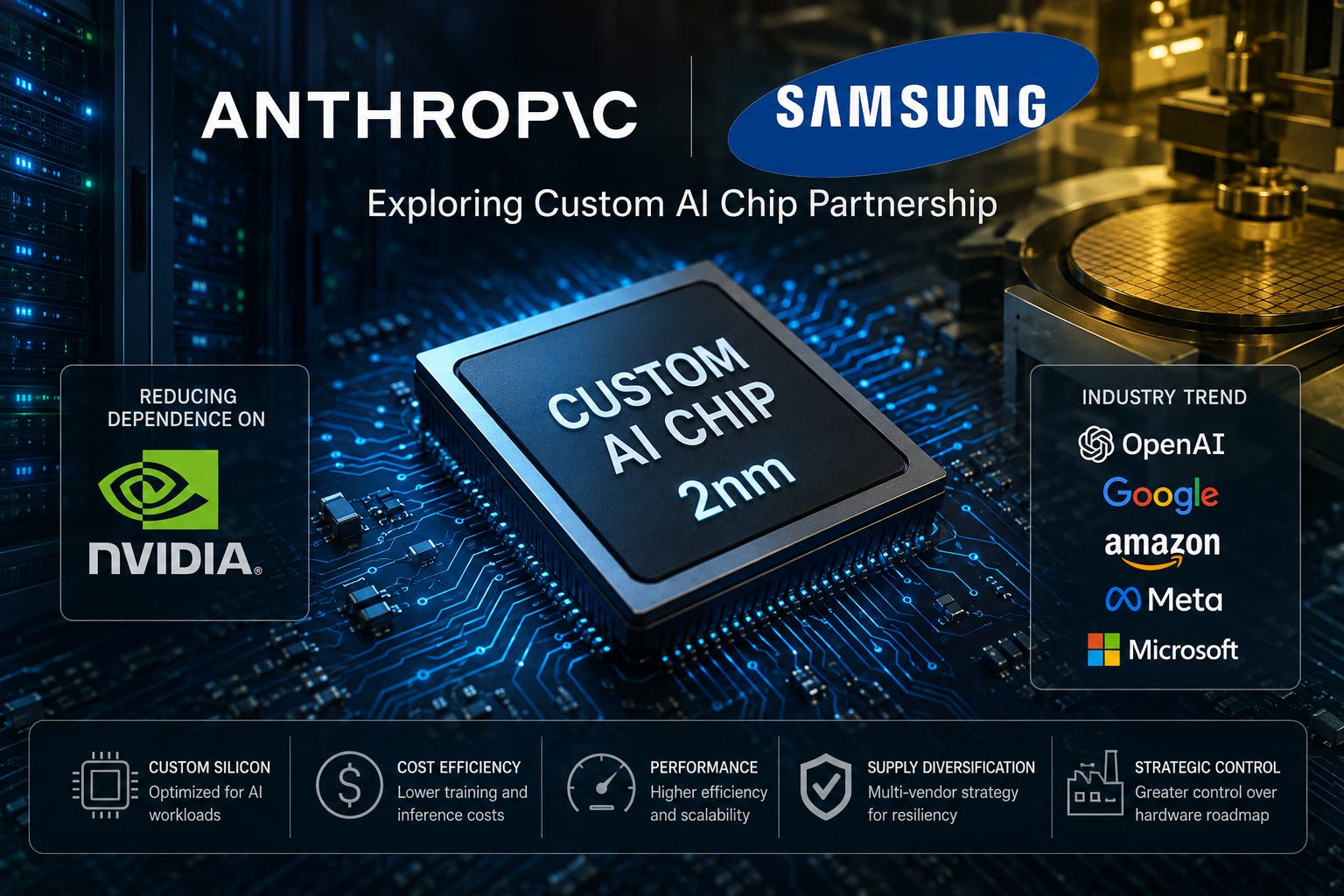
Artificial intelligence startup Anthropic is exploring the development of its first custom AI chip, holding early-stage discussions with Samsung Electronics over manufacturing the processor using Samsung’s upcoming 2nm process technology and advanced chip packaging capabilities. The initiative, first reported by The Information, reflects a broader shift among leading AI developers seeking greater control over their computing infrastructure while reducing long-term dependence on Nvidia, the dominant supplier of AI accelerators.
Although the project remains in a very early stage and no final manufacturing decision has been made, the discussions underscore how the AI hardware landscape is evolving beyond GPUs into a new era of vertically integrated silicon design.
Why Anthropic Is Considering Its Own AI Chip
Training and deploying large language models (LLMs) has become one of the most capital-intensive activities in the technology industry. As AI models grow larger and inference workloads continue to expand, leading AI companies are increasingly viewing custom silicon as a strategic necessity rather than a competitive luxury.
According to The Information, Anthropic has begun preliminary work on a proprietary AI chip and is evaluating Samsung’s 2nm fabrication process alongside its advanced semiconductor packaging technologies. The company has not finalized the chip’s architecture, manufacturing specifications, or production timeline, and the project could still be abandoned before reaching production.
To strengthen its internal semiconductor capabilities, Anthropic recently recruited Clive Chan, an early member of OpenAI’s custom chip engineering team, signaling the company’s intention to build long-term expertise in AI hardware development.
Following a Growing Industry Trend
Anthropic is far from alone in pursuing proprietary AI processors.
Over the past several years, nearly every major AI and cloud computing company has launched internal silicon programs designed to optimize AI performance while reducing reliance on third-party suppliers.
Most notably:
OpenAI partnered with Broadcom to develop its first custom inference chip, code-named Jalapeño, which was unveiled recently to improve the efficiency of running large language models.
Google has spent years deploying its Tensor Processing Units (TPUs) across its cloud infrastructure.
Amazon continues expanding its Trainium and Inferentia processors.
Microsoft has introduced its Maia AI accelerator.
Meta has also invested heavily in proprietary AI chips for internal workloads.
The objective is consistent across the industry: lower computing costs, improve energy efficiency, optimize AI workloads, and gain greater control over hardware roadmaps.
Despite these developments, Nvidia remains firmly entrenched as the industry’s dominant AI chip supplier. According to estimates cited by The Information, Nvidia still commands approximately 74% of the AI chip market, a share that has actually increased despite the proliferation of custom silicon initiatives.
A Potential Win for Samsung’s Foundry Business
Should Anthropic ultimately select Samsung as its manufacturing partner, the agreement would represent one of the highest-profile foundry victories in Samsung’s ongoing effort to challenge TSMC in advanced semiconductor manufacturing.
Samsung has invested aggressively in next-generation manufacturing technologies, particularly its upcoming 2nm process and advanced packaging capabilities. Winning a marquee AI customer like Anthropic would provide an important validation of its foundry business at a time when most leading AI chips continue to be manufactured by TSMC.
Samsung’s ambitions extend beyond Anthropic.
According to The Information, Google is also evaluating Samsung as a potential manufacturer for portions of future Tensor Processing Units (TPUs), potentially creating another significant opportunity for Samsung’s contract manufacturing business.
Earlier this week, Samsung Group and SK Group announced plans to invest approximately US$518 billion over the next decade to build four new semiconductor manufacturing complexes in South Korea. The massive investment highlights South Korea’s determination to strengthen its position within the global AI semiconductor supply chain.
Implications for the Semiconductor Industry
Anthropic’s exploration carries implications for several major semiconductor companies.
For Broadcom, the development reinforces growing demand for custom AI silicon following its existing collaboration with OpenAI.
For TSMC, Samsung’s pursuit of high-profile AI customers represents a potential long-term competitive challenge. While TSMC remains the industry’s clear leader in advanced-node manufacturing, Samsung has struggled historically with yield performance during previous leading-edge process transitions. Whether Samsung can achieve competitive yields on its 2nm technology will likely determine its ability to secure meaningful AI foundry market share.
Anthropic Is Pursuing Diversification, Not Replacement
Importantly, Anthropic has indicated that any future proprietary chip would complement rather than replace its existing computing partnerships.
In a statement cited by The Information, the company said:
“Amazon Web Services’s Trainium chip, Google tensor processing units and Nvidia graphic processors will remain central to how the company scales its compute strategy.”
The company is reportedly also evaluating processors from Microsoft as well as Fractile, a U.K.-based AI chip startup, highlighting a deliberate multi-vendor compute strategy designed to balance cost, performance, and supply resilience.
The Bigger Picture: AI Infrastructure Is Becoming More Diversified
Anthropic’s early exploration illustrates a broader transformation taking place across the AI industry.
Nvidia GPUs largely powered the first phase of the generative AI boom. The next phase appears increasingly focused on customized AI infrastructure, where cloud providers and AI model developers design chips tailored specifically to their workloads while partnering with multiple foundries and hardware suppliers.
Whether Samsung ultimately secures Anthropic as a manufacturing customer remains uncertain. The discussions are still preliminary, and technical challenges—particularly manufacturing yields at advanced process nodes—remain significant.
Nevertheless, the talks signal that competition in AI infrastructure is no longer limited to model performance. Increasingly, the battle is shifting deeper into semiconductor design, manufacturing, packaging, and supply chain strategy, areas that will likely shape the next decade of AI development.